
Where Alameda County Marriage Records Come From
Marriage licenses in Alameda County are issued by the Alameda County Clerk-Recorder, part of the Auditor-Controller/Clerk-Recorder agency. The Clerk-Recorder also issues birth and death certificates and keeps the official public record index. The court does not issue marriage licenses. That work is done at 1106 Madison Street in Oakland or at 7600 Dublin Boulevard, Suite 160 in Dublin.
Divorce records are a court file. Divorce, legal separation, and annulment cases move through the Alameda Superior Court Family Division at 510-267-6923. The court file holds the petition, response, financial disclosures, custody and support orders, and the final judgment that ends the marriage.
The image below is the official Clerk-Recorder home page.
That page routes the user to the right counter. The Clerk-Recorder handles marriage. The court handles divorce. Mixing the two is the most common mistake.
Public vs Confidential Marriage Licenses
California issues two kinds of marriage licenses, and Alameda offers both. A public license is open to anyone who pays the copy fee. A confidential license is a private record. Only the couple may buy copies, and they must show valid ID at the time of purchase. The state office in Sacramento does not sell confidential marriage copies at all. The only way to get one is to ask Alameda.
- Public license - any adult may apply, at least one witness signs, the record is public, anyone can buy a copy.
- Confidential license - both parties live together as spouses at application, no witness signs, the record is restricted, only the couple may buy a copy.
- Either license - may be issued by any California county and used for a ceremony anywhere in the state.
- Either license - is good for 90 days from the date of issue, then it expires.
The image below is from the marriage license types page.
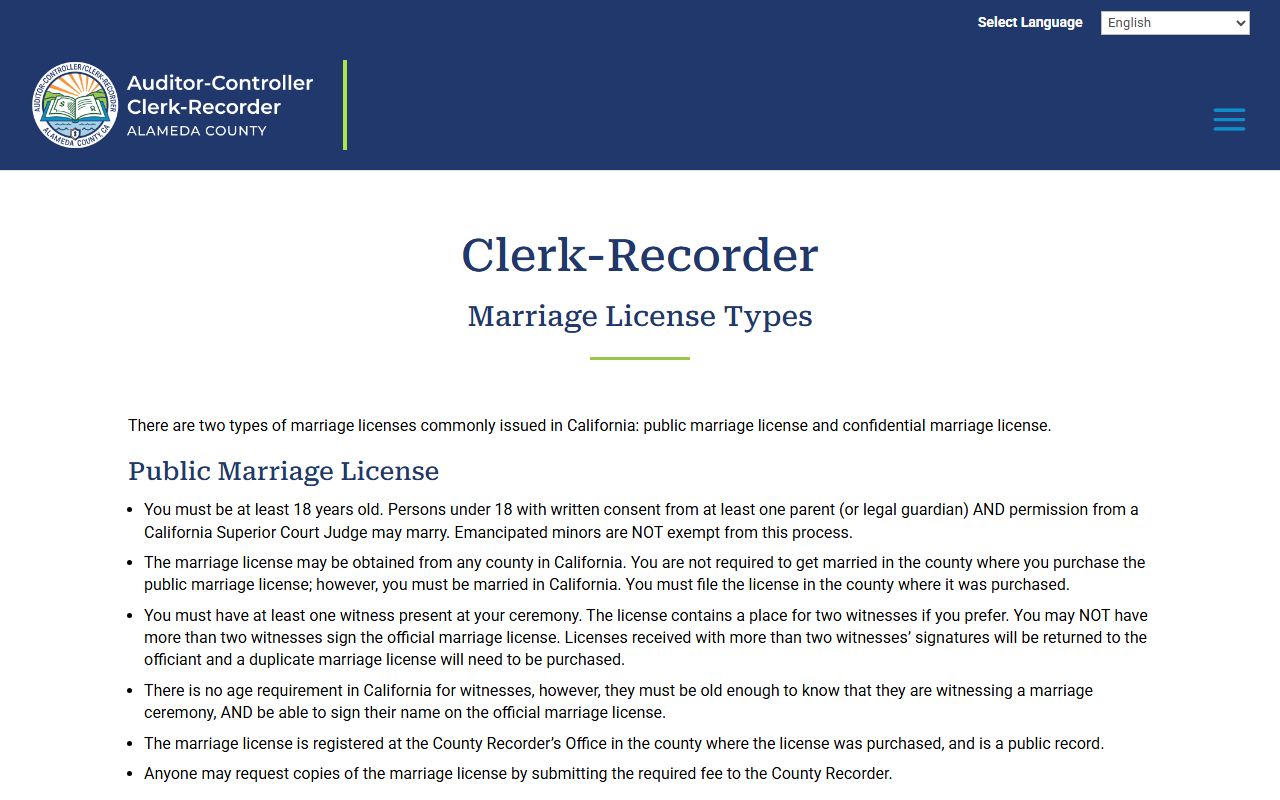
That page flags that more than two witness signatures will void a public license.
Marriage License Application Requirements
Both parties must come to the office at the same time. Each must be at least 18, or follow the under-18 court and parental process. Each must show valid government-issued photo ID with full legal name and date of birth. A digital ID on a phone is not accepted. A photo or screenshot of an ID is not accepted. If the ID does not show the full legal name, the office requires a certified birth certificate or a court-ordered name change.
If either party was married before, or was in a State Registered Domestic Partnership, the office needs the exact end date and the manner of the end. If that end was within the last 30 days, the office also wants a certified copy of the final judgment.
| Field or Requirement | Type | Required | Notes |
|---|---|---|---|
| Party 1 legal name | Text | Yes | Must match the valid government ID or a certified supporting document. |
| Party 2 legal name | Text | Yes | Same rule as Party 1. |
| Proof of date of birth and name | Photo ID | Yes | Driver license, state ID, U.S. passport, military ID, or consulate card. No digital ID. |
| Prior marriage or SRDP end date | Date | If applies | Required if either party was married or in an SRDP before. |
| Manner ended | Selection | If applies | Death, dissolution, divorce, or annulment. |
| Certified final judgment | Document | If applies | Required if the prior marriage or SRDP ended within the last 30 days. |
| License type | Selection | Yes | Public or confidential. |
| Cohabitation affidavit | Signed affidavit | If applies | Confidential license only. |
| Ceremony appointment | Booking | If applies | Required for in-office ceremonies at the Oakland wedding room. |
| Payment | Cash or card | Yes | Fee depends on the service. In-person card use adds 2.3 percent. |
Note: The Clerk-Recorder will return a public license that carries more than two witness signatures, and the couple will have to buy a duplicate license to fix it.
Marriage License Fees in Alameda County
The Clerk-Recorder posts a flat fee for each marriage service. The fee is the same at Oakland and Dublin. Filing fees for divorce cases are set by the court and are not in the table below. The office accepts cash, debit, major cards, check, money order, cashier's check, and traveler's check.
| Service | Fee |
|---|---|
| Public marriage license | $81.00 |
| Confidential marriage license | $90.00 |
| Marriage ceremony | $75.00 |
| Express marriage ceremony | $75.00 |
| Certified copy of a marriage record | $21.00 each |
| One-Time Deputy Marriage Commissioner | $75.00 |
| In-person credit card transaction fee | 2.3% |
A couple who wants a friend or family member to officiate just one ceremony can use the One-Time Deputy Marriage Commissioner option for $75. The office swears the person in for that one day. After the ceremony, the deputy returns the license for filing.
Marriage Ceremonies in Alameda County
Marriage ceremonies are by appointment only and are held at the Oakland Clerk-Recorder office in a small wedding room. Virtual ceremonies are offered when both parties are physically in California at the time of the call. Outside ceremonies are common too. A couple can take the license to a venue, a park, or a home and have a qualified officiant perform the rite.
The 90-day rule is the key date. A California marriage license is good for 90 days from the date it is issued. If the ceremony does not happen in that window, the license expires and the couple has to buy a new one.
- In-office - the certificate can be provided during the same visit.
- Virtual - the certificate is mailed after the office registers the license.
- Outside - the signed license is returned to Alameda, then the certificate is mailed.
The image below is the marriage services page.
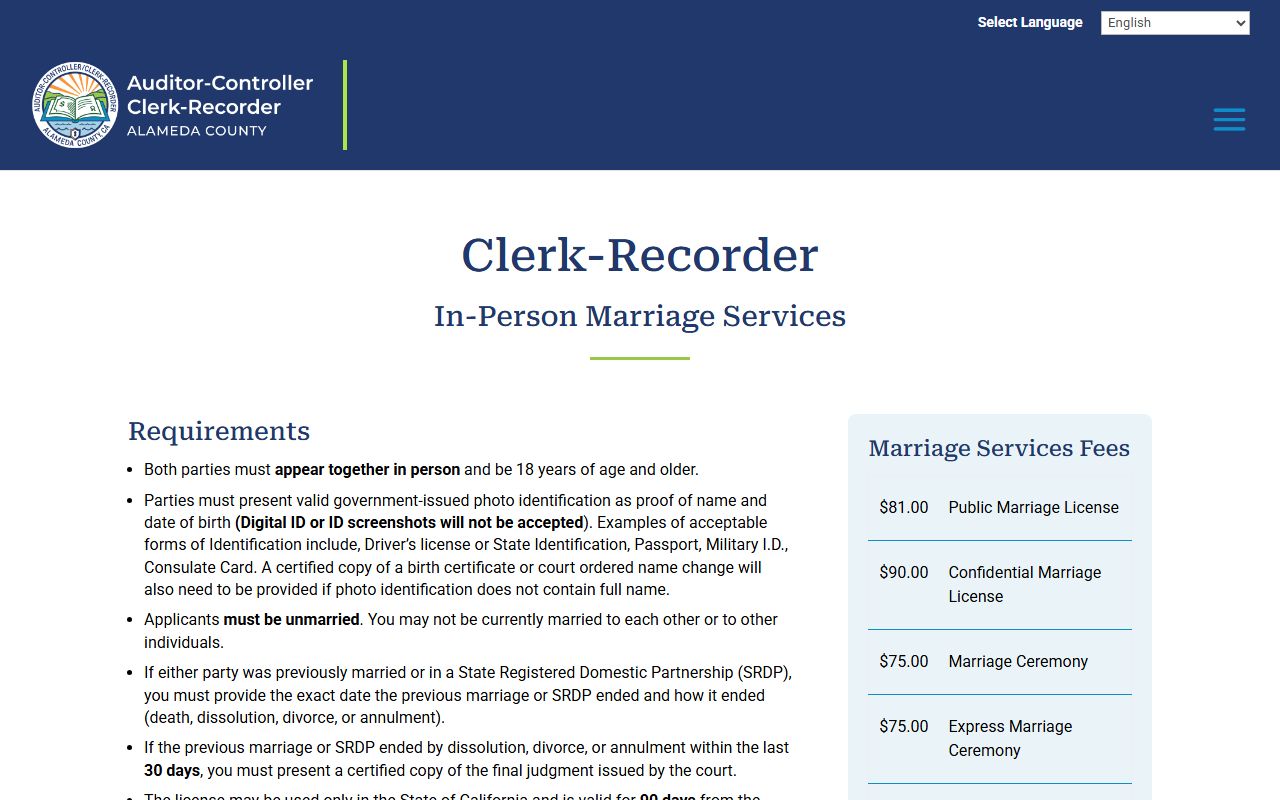
That page lists the daily cutoff. No license is issued after 4:00 PM.
How to Apply for an Alameda County Marriage License
The license application is a single in-person visit. No appointment is required for the license itself, but the office cuts off service at 4:00 PM and asks couples to arrive by 3:45 PM. A ceremony appointment is a separate booking.
- Decide public or confidential. A public license needs a witness. A confidential license needs the couple to live together as spouses and sign an affidavit, with no witness at the ceremony.
- Gather identification. Each party brings a valid government photo ID. A digital ID or screenshot is not accepted. If the ID does not show the full legal name, bring a certified birth certificate or court-ordered name change.
- Confirm prior-marriage details. Bring the exact end date and manner of any prior marriage or SRDP. If the end was within 30 days, bring a certified final judgment.
- Go to the Oakland or Dublin office before the 4:00 PM cutoff. Both parties must appear at the same time.
- Pay the fee. Public is $81, confidential is $90. In-person card use adds 2.3 percent.
- Hold the ceremony within 90 days. After 90 days the license expires and a new one is needed.
- Return the signed license to the Alameda office for registration. The certificate is given during the visit for in-office ceremonies, or mailed later for virtual and outside ceremonies.
The image below is from the Clerk-Recorder contact page.
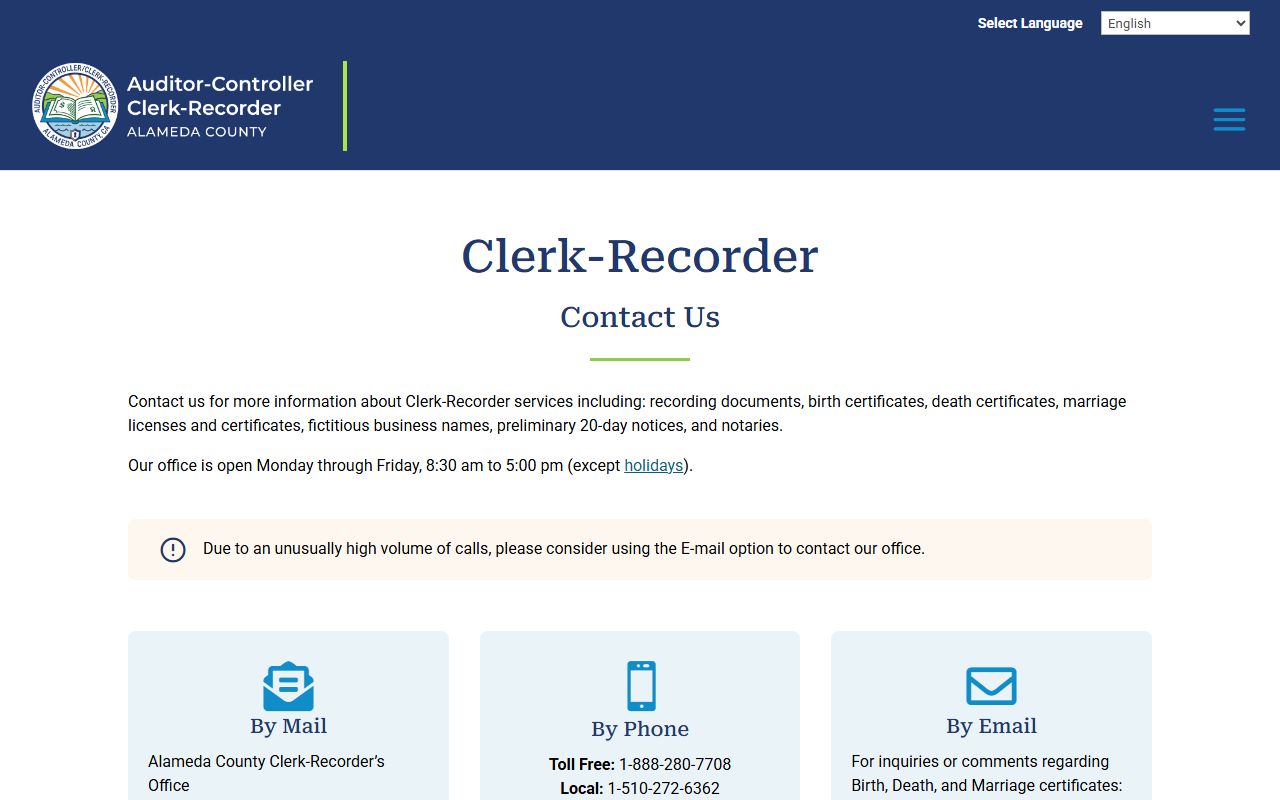
The contact page is the right place to check holiday hours. The office closes on county holidays even when the courts are open.
Common Marriage License Pitfalls
Many couples lose a day at the counter for one of a few reasons. The most common is the digital ID rule. A phone wallet ID is not accepted, even when California has approved it for some uses. The next is the witness count on the public license. A public license has space for two witness signatures and no more.
- Digital ID - the office does not accept a phone ID or a photo of an ID.
- Two-witness max - a third witness signature voids the public license.
- 30-day rule - a prior marriage that ended within 30 days requires a certified final judgment.
- 90-day window - the license expires 90 days after issue.
- Confidential copies - only the couple may buy copies; the state office does not sell them.
The image below is from the Clerk-Recorder FAQ.
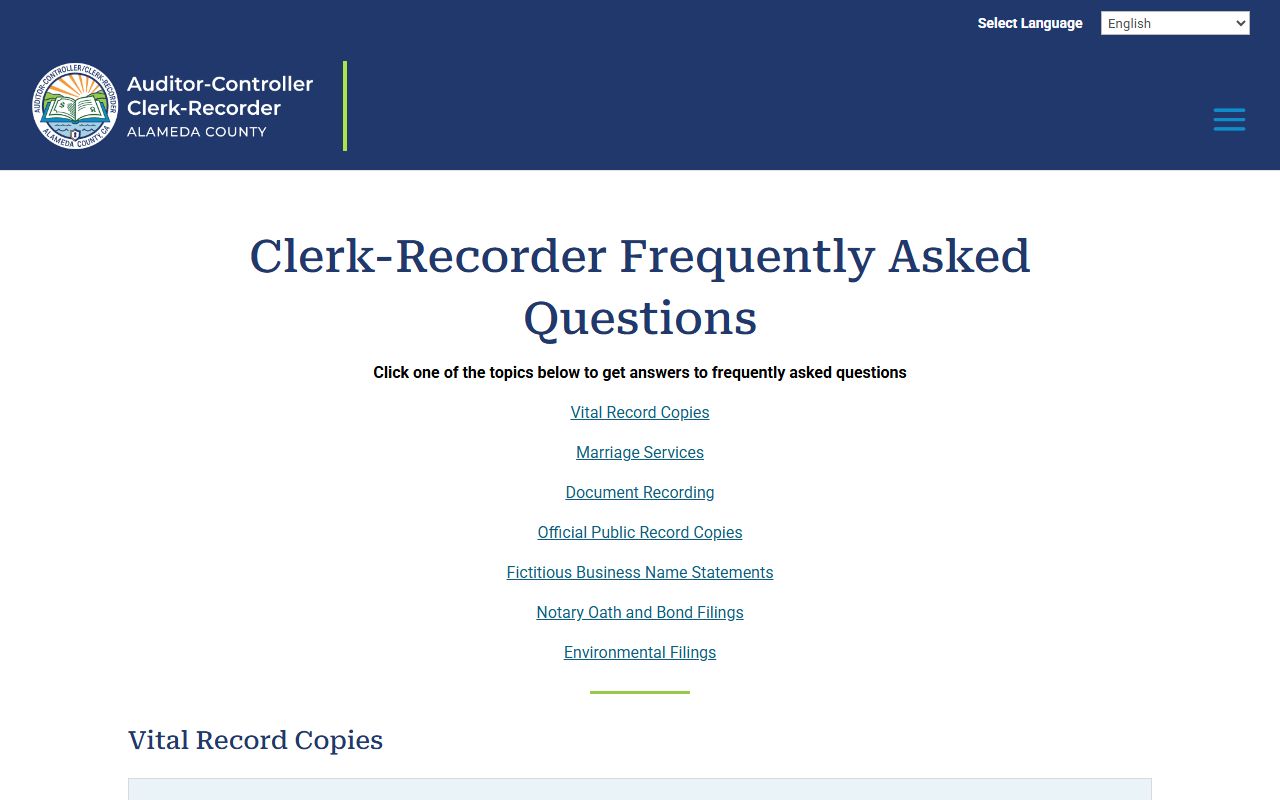
The FAQ answers most counter questions in advance and saves a return trip.
Alameda County Divorce Records
Divorce in Alameda County is a Superior Court matter, not a Clerk-Recorder one. Divorce, legal separation, and annulment cases sit with the Family Division at 510-267-6923. California is a no-fault divorce state. A spouse does not have to prove the other side did something wrong. Irreconcilable differences is enough.
The case runs through standard Judicial Council forms. The petition starts the case. The other spouse is served. Both sides exchange financial disclosures. Custody, support, and property are resolved by agreement, default, or trial. The judge signs a final judgment that ends the marriage.
The Clerk-Recorder does not keep divorce decrees. A request for a divorce decree goes to the Superior Court records office.
Searching Divorce Records in eCourt
Family law case status is checked through the Alameda eCourt Public Portal. A free account is needed. The portal supports case number search, name search, and calendar search by department. Documents can be downloaded for a credit fee, and a free half-page preview is shown before the full charge.
Some divorce filings are restricted. Financial disclosures are confidential. Custody evaluations are not online. For sealed files, the records office at 510-891-6005 is the right contact. For more on eCourt search, see the court records page or the public records page.
Divorce Self-Help and Workshops
The Alameda Self-Help Center is the main free resource for people who file a divorce without a lawyer. The Self-Help Center line is 510-272-1393. Self-Help staff cannot give legal advice, but they walk filers through the right Judicial Council forms, the local rules, and the most common errors. The center also offers a start-divorce workshop and a financial disclosure workshop, which cover the two stages where most pro se filers get stuck.
People facing a divorce that involves abuse, threats, or stalking should also know about the Family Violence Law Center at 510-208-0220. The center provides free legal help for survivors in restraining order, custody, and family law cases. The Self-Help Center can refer cases that involve a safety risk to that office. Both lines are independent of the court clerk, so a caller does not need a case number to reach them.
- Self-Help Center - 510-272-1393, divorce, custody, and support forms guidance.
- Family Violence Law Center - 510-208-0220, legal help for survivors of abuse in family law cases.
- Start-divorce workshop - covers the petition, summons, and first filings.
- Financial disclosure workshop - covers the income and expense forms both spouses must trade.
- Default judgment workshop - for cases where the other spouse never answers.
Note: Self-Help Center staff are court staff and cannot represent a party in court or give an opinion on the right legal strategy.
Cross-Reference to Probate
Probate sits next to marriage and divorce in the family record world. A spouse who dies during a divorce case ends the case, and the surviving spouse may have to open a probate to handle the estate. A marriage certificate is the proof of spouse status in a probate. A divorce judgment is the proof that a former spouse is no longer a spouse for purposes of community property. For estate filings, see the probate records page. For Clerk of Court contact and certified copy steps, see the clerk of the Superior Court page.
The image below is from the Clerk-Recorder forms page, which lists the marriage certificate order forms.
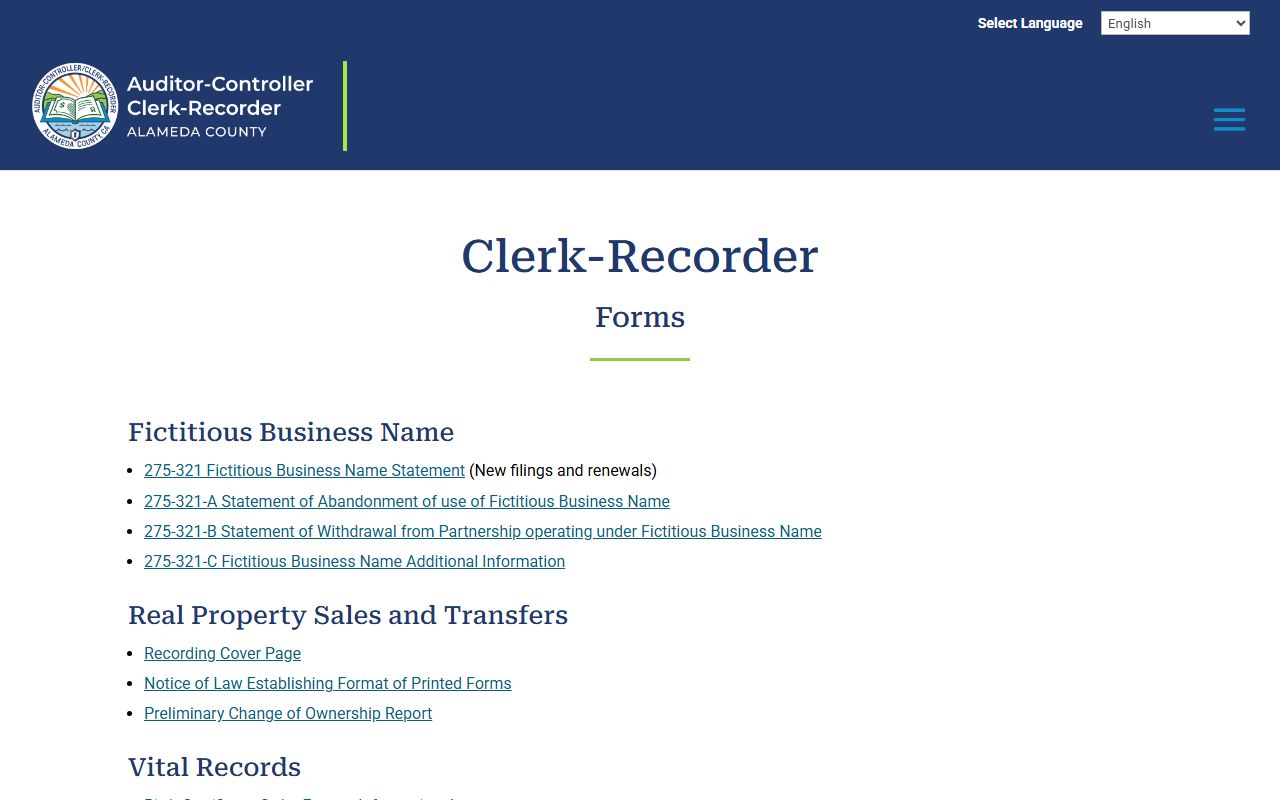
The forms page lists three marriage certificate order forms, one for confidential records, one for unrestricted certified copies, and one for informational copies. A mail-in request for a certified copy requires a notarized sworn statement on the form.
Alameda County Clerk-Recorder Contact
Both Clerk-Recorder offices issue marriage licenses, perform express ceremonies, and accept marriage certificate orders. The Oakland office is the only one that hosts in-person ceremonies in the wedding room. The Dublin office is a select-service location and does not accept mail transactions. The two contact cards below pull from the official Clerk-Recorder contact page.
Clerk-Recorder, Oakland
1106 Madison Street
Oakland, CA 94607
510-272-6362
1-888-280-7708
TDD 510-444-1396
Mon-Fri, 8:30 AM - 5:00 PM
Clerk-Recorder, Dublin
7600 Dublin Boulevard, Suite 160
Dublin, CA 94568
510-272-6362
1-888-280-7708
Mon-Fri, 8:30 AM - 5:00 PM
Select-service; no mail transactions
Avoid the noon to 2:00 PM window if speed matters. The office flags that block as the busiest hour at the Oakland counter.