
How to Search Alameda County Traffic Court Records
Most Alameda County traffic court records live in one place: the traffic ticket lookup tool linked from the court's Public Portals page. The tool sits outside eCourt and the Criminal Online Records Search. It looks up a citation, shows the fine and court date, and lets a driver pay, sign up for traffic school, ask for more time, or print a courtesy notice. There is no free-text case browse and no bulk file.
The fastest search uses the citation number printed on the ticket. When the ticket is lost, the tool also takes a California driver's license number or, for some functions, a name plus date of birth. A captcha must be solved before the form runs. If nothing shows, the case may not be filed yet, the spelling may not match, or the cite may belong to a court outside Alameda.
The screenshot below comes from the Alameda Superior Court Public Portals page, which routes drivers to the correct traffic tool.
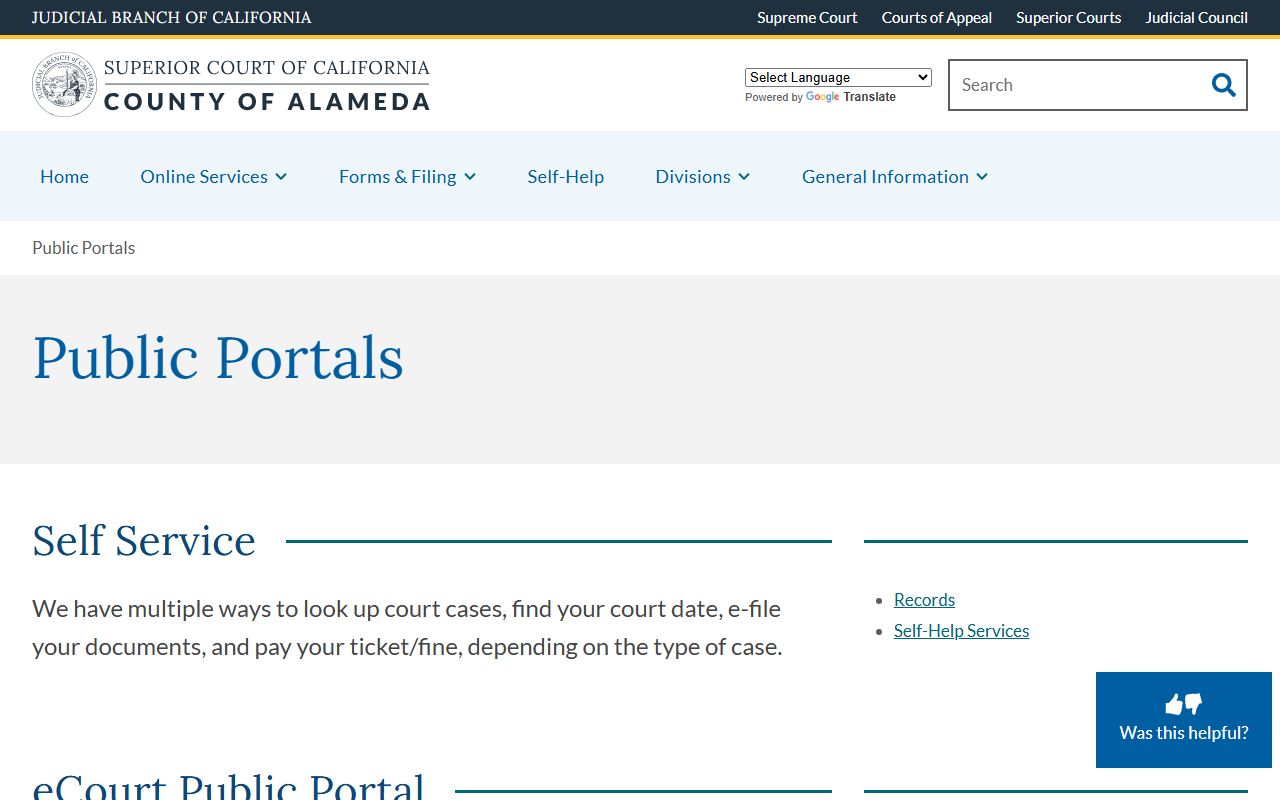
The portals page is the safest starting point because each official tool is listed with a short note on what it does.
Which Courts Handle Traffic Cases in Alameda County
Alameda runs a unified Superior Court, so there is no separate municipal or justice court for traffic. The work is split across three clerk sites by region. North County tickets, including most Oakland and Berkeley cites, route to Wiley W. Manuel. South County tickets route to Fremont. East County tickets route to Dublin. A few traffic-related criminal calendars also sit at the René C. Davidson Courthouse downtown.
The right courthouse for a ticket is printed on the citation and confirmed in the courtesy notice. Each clerk handles only the cases assigned to its building. The online traffic tool routes payment and traffic school steps to the correct file no matter which site the driver picks.
| Courthouse | Address | Phone | Traffic Role |
|---|---|---|---|
| Wiley W. Manuel Courthouse | 661 Washington Street, Oakland, CA 94607 | 510-627-4700 | Primary Oakland and North County traffic clerk; CARE Act and misdemeanor drug court in the same building. |
| Fremont Hall of Justice | 39439 Paseo Padre Parkway, Fremont, CA 94538 | 510-818-7500 | South County traffic clerk; criminal and infraction calendars. |
| East County Hall of Justice | 5151 Gleason Drive, Dublin, CA 94568 | 925-227-6700 | East County traffic and criminal clerk; felony drug court calendars. |
| René C. Davidson Courthouse | 1225 Fallon Street, Oakland, CA 94612 | 510-891-6000 | Some traffic-related criminal departments and overflow; DUI cases that move to criminal often sit here or at Wiley Manuel. |
The screenshot below comes from the Alameda Superior Court phone directory, which lists clerk numbers by division and site.
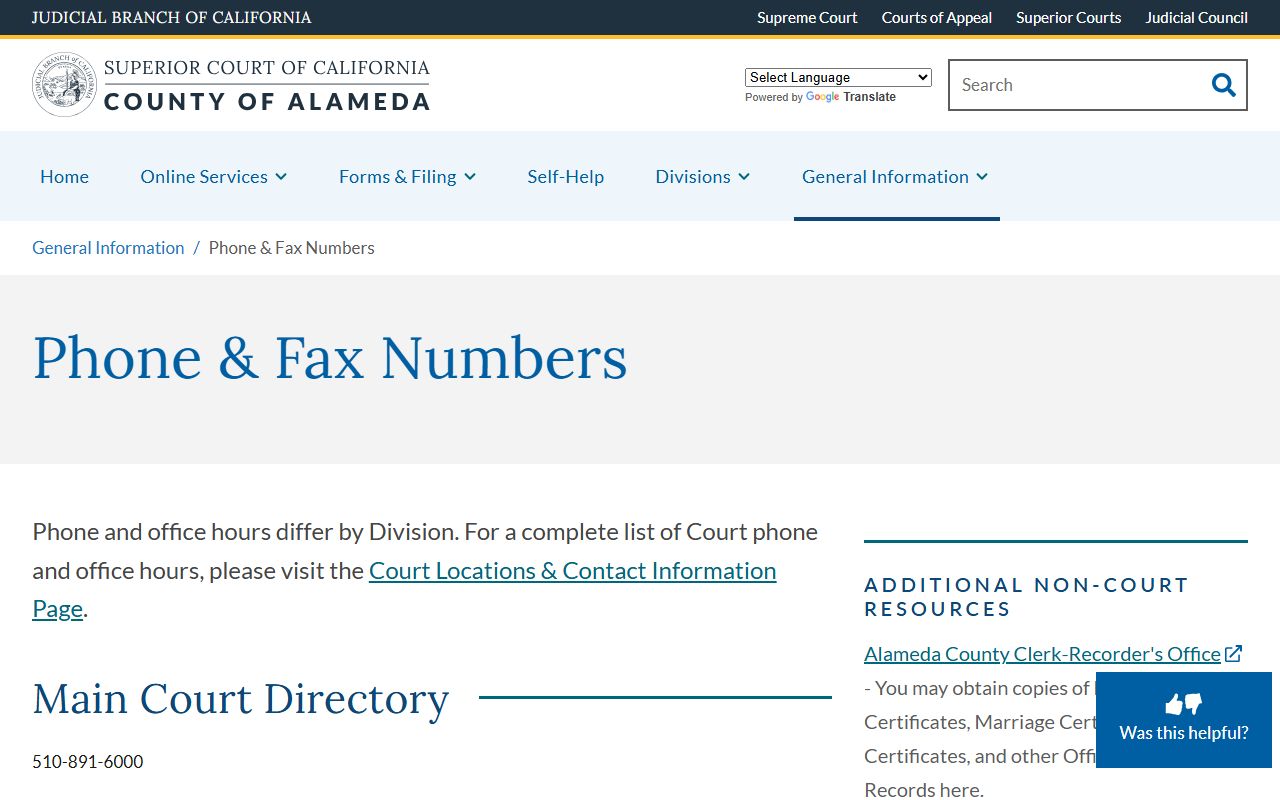
The directory helps when the online tool cannot find a ticket; a direct call to the right clerk often clears up a spelling or date that the search form rejects.
Types of Traffic Cases on Record
California treats most traffic offenses as infractions under Vehicle Code § 40000.1, which sets the baseline rule that a Vehicle Code violation is an infraction unless the code says otherwise. An infraction has no jail time and no jury trial. Misdemeanor and felony driving offenses route off the traffic calendar and into the criminal calendar.
Alameda's traffic ticket file covers the full mix. The lookup tool pulls red light, stop sign, and speeding cites. DUI cases under Vehicle Code § 23152 show in the criminal system, not the traffic tool.
- Moving infractions - speeding, red light, stop sign, unsafe lane change, failure to yield, and similar Vehicle Code citations.
- Non-moving infractions - expired registration, no proof of insurance, equipment violations, and seat belt cases.
- Photo enforcement - red light camera tickets filed under standard Vehicle Code sections with the issuing agency named on the cite.
- Misdemeanor traffic - reckless driving, hit and run, and driving on a suspended license; many of these route to a criminal calendar.
- DUI / DWI - charges under Vehicle Code § 23152 filed as misdemeanors or felonies; tracked on the criminal records page.
- Commercial driver matters - tickets involving a CDL holder face stricter rules under Vehicle Code § 15300.
What Alameda County Traffic Court Records Show
A standard Alameda traffic file tracks the cite from issue to close. The citation number is the spine. The file then lists who wrote the ticket, what code was cited, when and where the stop happened, what bail was set, which courthouse will hear it, and what the driver has done about it. Civil assessments, traffic school steps, and bench warrants appear as later entries.
| Field | What It Shows |
|---|---|
| Citation Number | Unique court ID for the ticket, printed on the cite and on any courtesy notice. |
| Issuing Agency | Police, sheriff, CHP, or other agency that wrote the ticket. |
| Violation Code | Vehicle Code section cited, such as § 22350 unsafe speed, § 21453 red light, or § 23152 DUI. |
| Violation Date and Location | When and where the stop or photo cite was issued. |
| Court Location | Which courthouse will hear the case, usually Wiley Manuel, Fremont, or East County. |
| Court Date | First appearance or arraignment date for the infraction or misdemeanor. |
| Bail / Fine Amount | Posted bail or fine, set by the Alameda bail and fine schedule. |
| Payment Status | Paid in full, partial, on an installment plan, late, or on hold. |
| Traffic School Status | Eligible, enrolled, completed, or denied. |
| Civil Assessment | $300 add-on under Penal Code § 1214.1 when a failure to appear or pay is found. |
| Disposition | Conviction, dismissal, transfer, or referral to a criminal calendar. |
| Outstanding Warrant | Notice that a bench warrant has issued for failure to appear. |
The screenshot below comes from the Alameda Fee and Bail Schedules page, which lists the current schedule used for these traffic records.
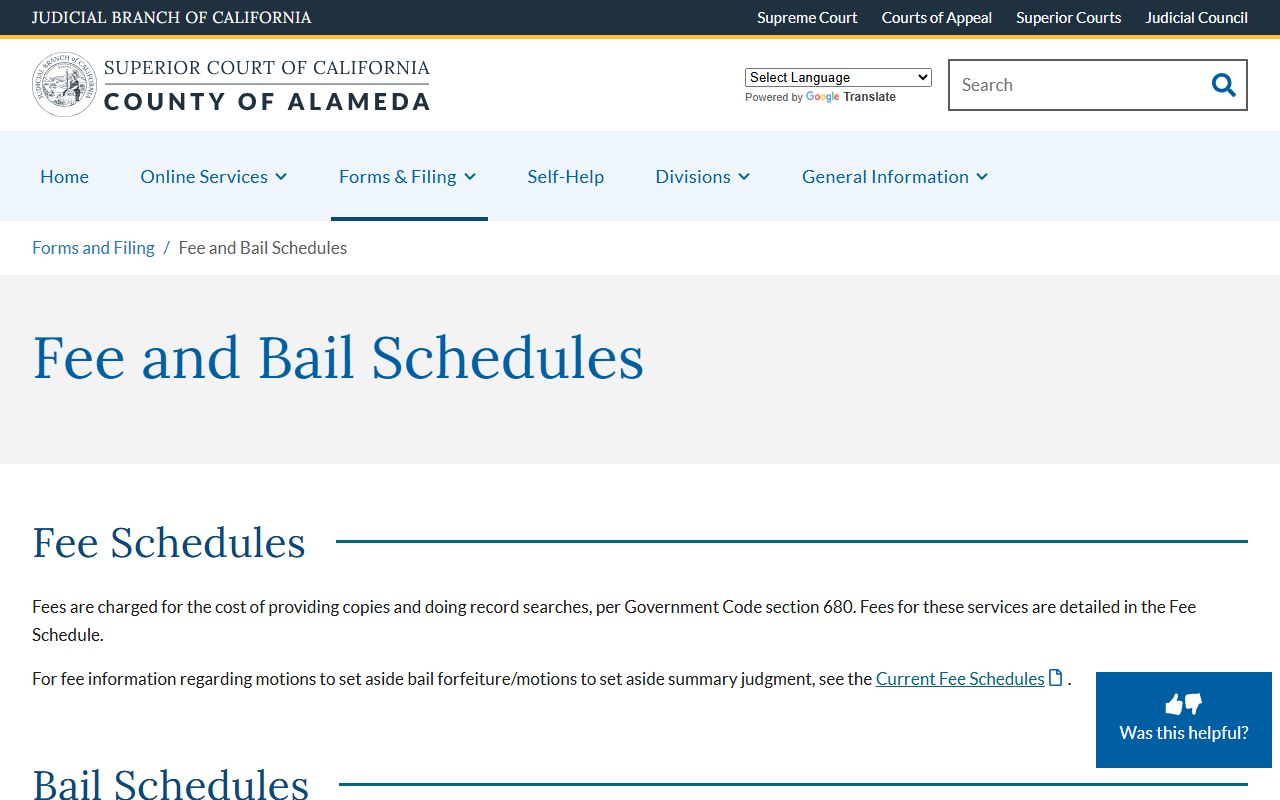
Check the fee page before paying a cite; state penalty assessments and local add-ons often change the final bail.
Searching by Citation Number vs by Name
The Alameda traffic ticket tool is built for short, exact lookups. Most users start with the citation number because it routes straight to the case. When the ticket is gone, a California driver's license number is the next best key. A name plus date of birth works for some functions but not all. Each search needs a captcha.
| Field | Type | Required | Notes |
|---|---|---|---|
| Citation Number | text | conditional | Primary search route; printed on the ticket and on the courtesy notice. |
| Driver's License Number | text | conditional | Used when the citation number is not on hand; tied to the state driver record format. |
| Name (Last, First) | text | conditional | Secondary lookup when both citation and license are unknown. |
| Date of Birth | date | conditional | Confirms identity against the citation. |
| Captcha | input | required | Human-verification step before any submit. |
| Function | radio / select | required | Pay fine or forfeit bail, pay traffic school fees, request extension, request traffic school, or view courtesy notice. |
| Submit / Lookup | button | required | Runs the citation query. |
If the cite cannot be found online, the traffic clerk can confirm the case by phone using name, date of birth, and an approximate violation date. The court does not run a name browse like the civil eCourt.
Note: A search that returns nothing in the first few days after a stop often just means the citation has not been filed by the agency yet; try again after one full week.
Paying or Contesting an Alameda County Traffic Ticket
The Alameda traffic ticket tool gives a driver a short menu. The fast route is to pay the bail or fine in full. A slower route is to ask for an extension, set up a payment plan, sign up for traffic school, or set the case for trial. Each step has a deadline. Missing the due date can add a $300 civil assessment under Penal Code § 1214.1 and can put the case on a bench warrant.
A driver who wants to fight the cite has two routes. A trial by written declaration lets the driver argue in writing; the officer also writes a statement, and the judge decides. A trial in court is the in-person option. Bail is often posted up front and refunded if the driver wins.
- Find the citation. Use the citation number on the ticket or the courtesy notice to load the case in the Alameda traffic ticket tool.
- Pick a path. Pay in full, ask for an extension, set up a payment plan, sign up for traffic school, or set the case for trial.
- Pay or post bail. Use a card in the online tool, mail a check to the listed courthouse, or pay in person at the traffic clerk window.
- Sign up for traffic school if eligible. Pick a state-certified course, pay the court's school fee, and complete the class by the deadline.
- For trial by written declaration, file Form TR-205 and the bail before the due date and wait for the judge's ruling.
- For trial in court, ask the clerk to set the trial date and show up on time; bring a written statement and any photos.
- If a deadline is missed, contact the traffic clerk fast to ask about lifting any failure to appear before the civil assessment is added.
The court's Self-Help Center lists partner clinics, including the East Bay Community Law Center's traffic clinic. Self-Help staff cannot give legal advice but can explain forms, deadlines, and the basic court flow at no cost.
Public Access Laws for Traffic Court Records
Court adjudicative records, including traffic case files, are presumed open under California common law and court rules. Agency records fall under the California Public Records Act at Government Code § 7920.000. Court entries follow court rules; DMV driver records follow DMV release rules under the Vehicle Code.
Several pieces of a traffic case stay out of public view. Juvenile traffic matters are confidential under Welfare and Institutions Code § 827 and Rules of Court rule 5.551. License numbers, birth dates, addresses, and medical notes are redacted. For a court-ready copy, ask for a certified copy from the traffic clerk; an online printout is not certified.
Court Traffic Records vs State Driver Records
The court file and the state driver record are two different things. The Alameda Superior Court keeps the case file for a citation filed in the county. The California DMV keeps a separate driver history with convictions, accidents reported, suspensions, restrictions, CDL status, and points. Proof of one ticket goes through the court; a full driving history goes through the DMV.
| Topic | Court Traffic Record (Alameda Superior Court) | State Driver Record (California DMV) |
|---|---|---|
| Record source | Alameda Superior Court traffic case file for a citation filed in the county. | DMV driver history file that tracks all California convictions, points, and license status. |
| What it shows | Citation number, charge, court date, bail, fine, payment status, traffic school status, disposition. | Convictions, accidents reported, suspensions, restrictions, CDL endorsements, points, and license status. |
| Where it lives | Alameda traffic system; reached through the court's traffic ticket lookup tool. | DMV driver record database in Sacramento. |
| How to access | Online through the traffic ticket tool, in person at Wiley Manuel, Fremont, or East County, or by phone with the clerk. | Online via the DMV online driver record request, in person at a DMV field office, or by mail to DMV Sacramento. |
| How to correct errors | Contact the Alameda traffic clerk; file a motion with the trial court if needed. | Submit a request for review to DMV with supporting court documents and certified copies. |
Both files matter when a driver checks a record before a job, a lease, or an insurance review. A court win does not always show on the DMV file right away, and a DMV change does not push back to the court file at all. When in doubt, pull both.
Note: Insurance companies and most employers buy the DMV driver record, not the court traffic file, so a clean DMV record is usually the goal of any contest or traffic school request.
CDL and Commercial Driver Records
Commercial driver license holders face a tougher set of rules under Vehicle Code § 15300 and the federal CDL rules that California has adopted. Convictions for serious traffic violations can disqualify a CDL holder, even when the cite was issued in a private car off duty. The state must report the conviction to the home state and, in many cases, to the federal Commercial Driver License Information System.
Traffic school is generally not available to a CDL holder for the purpose of hiding a conviction from the driving record. The court will still accept a class, but the conviction still posts to the DMV file. A CDL driver who gets a cite should talk to counsel before signing up to pay, because options that look the same on the surface can lead to very different outcomes for the commercial endorsement. The Alameda traffic clerk can confirm whether the case is on the right calendar but cannot give CDL advice.
DUI and DWI Cases
A driving under the influence charge under Vehicle Code § 23152 is filed as a misdemeanor or a felony, not as a simple infraction. DUI cases do not show up in the Alameda traffic ticket tool. They sit on the criminal calendar, and the file is in the Criminal Online Records Search rather than the traffic system. The DMV also runs its own administrative track in parallel with the court case, and a license suspension can attach even before the criminal case ends.
Defendants in Alameda DUI cases usually appear at Wiley W. Manuel Courthouse or the René C. Davidson Courthouse, depending on assignment. For full detail on charges, plea, sentence, and post-conviction relief, see the Alameda County criminal records page. Bench warrants tied to a missed DUI hearing show on the warrant records page.
Deferred Adjudication and Defensive Driving
California uses traffic violator school as its main form of deferred treatment for minor moving violations. The rules live in Vehicle Code § 42005. An eligible driver pays the fine plus a court-set school fee, picks a state-certified school, and finishes the class by a deadline. If the court accepts the work, the conviction is held confidentially on the DMV file so that no point posts for insurance use. The case is not erased; it is shielded from public DMV release.
Eligibility is narrow. The driver must hold a non-commercial Class C license, the offense must be a minor moving violation that is not alcohol or drug related, and the driver can use traffic school only once every 18 months on the DMV record. Some cites are barred by statute. The Alameda traffic ticket tool supports paying the traffic school fee and confirming receipt of the school's completion certificate. A driver who is unsure about eligibility should call the traffic clerk before paying for the class.
Sealing or Expunging Traffic Records
Most traffic infractions never produce a fingerprint record under Penal Code § 11105, so the regular arrest-record sealing routes under Penal Code §§ 851.91 and 851.8 usually do not apply. The cite still sits on the court's traffic file and, after a conviction, on the DMV driver record. The driver record is the file that fades over time on its own under DMV rules.
A misdemeanor traffic conviction, including some DUI cases under Vehicle Code § 23152, may be eligible for relief under Penal Code § 1203.4 after probation is completed in full. That statute is often called expungement, but it has limits. It does not erase the case for DMV purposes, it does not lift a license suspension, and it does not protect a CDL holder from a federal commercial disqualification. For a juvenile traffic matter, sealing follows the juvenile rules under Welfare and Institutions Code § 827 and California Rules of Court rule 5.551, not the adult sealing statutes. For broader questions about record cleaning, see the Alameda County Court Records FAQ and the court records page.
Fees for Traffic Record Copies
Traffic fees fall into two buckets. The first is the bail or fine on the citation itself, set by the Alameda bail and fine schedule and adjusted by state penalty assessments. The second is the cost of paperwork: a traffic school admin fee, an extension cost when one applies, a civil assessment for missing a deadline, and a court-set fee for a certified copy of a record. The DMV charges its own fee for a driver record, on top of any court fee.
| Service | Fee / Rule |
|---|---|
| Bail or fine for a cited infraction | Per Alameda bail and fine schedule; from about $25 for low-level cites to several hundred dollars for higher Vehicle Code violations, plus state penalty assessments. |
| Civil assessment for failure to appear or pay | $300 under Penal Code § 1214.1. |
| Traffic violator school admin fee | Set by the court under Vehicle Code § 42007; added to the base fine. |
| Court-certified copy of a traffic record | Per the court fee schedule on the Fee and Bail Schedules page. |
| Extension request | No extra cost when filed through the court tool before the due date; late requests can trigger civil assessment. |
| DMV online driver record | DMV fee schedule applies; check dmv.ca.gov for the current cost. |
| Failure-to-appear bench warrant clearance | Cost set by the criminal division; see the warrant records page. |
The screenshot below comes from the official California record law page for Penal Code § 1203.4, the post-probation dismissal statute that may apply to a misdemeanor traffic conviction.
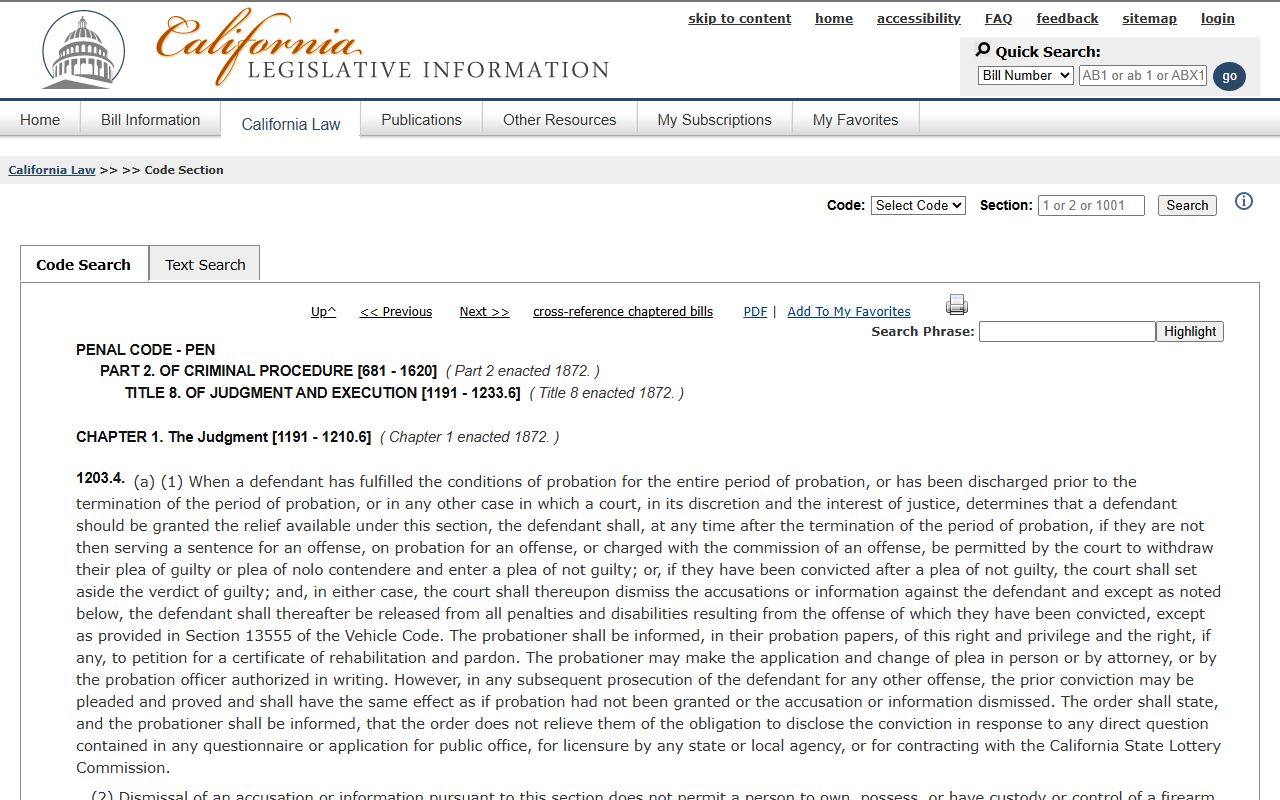
The statute page sets out the steps a driver follows to ask the court to dismiss a qualifying conviction. It is one of the few record-cleaning tools that touches misdemeanor traffic at all.