
California Public Records Act Framework
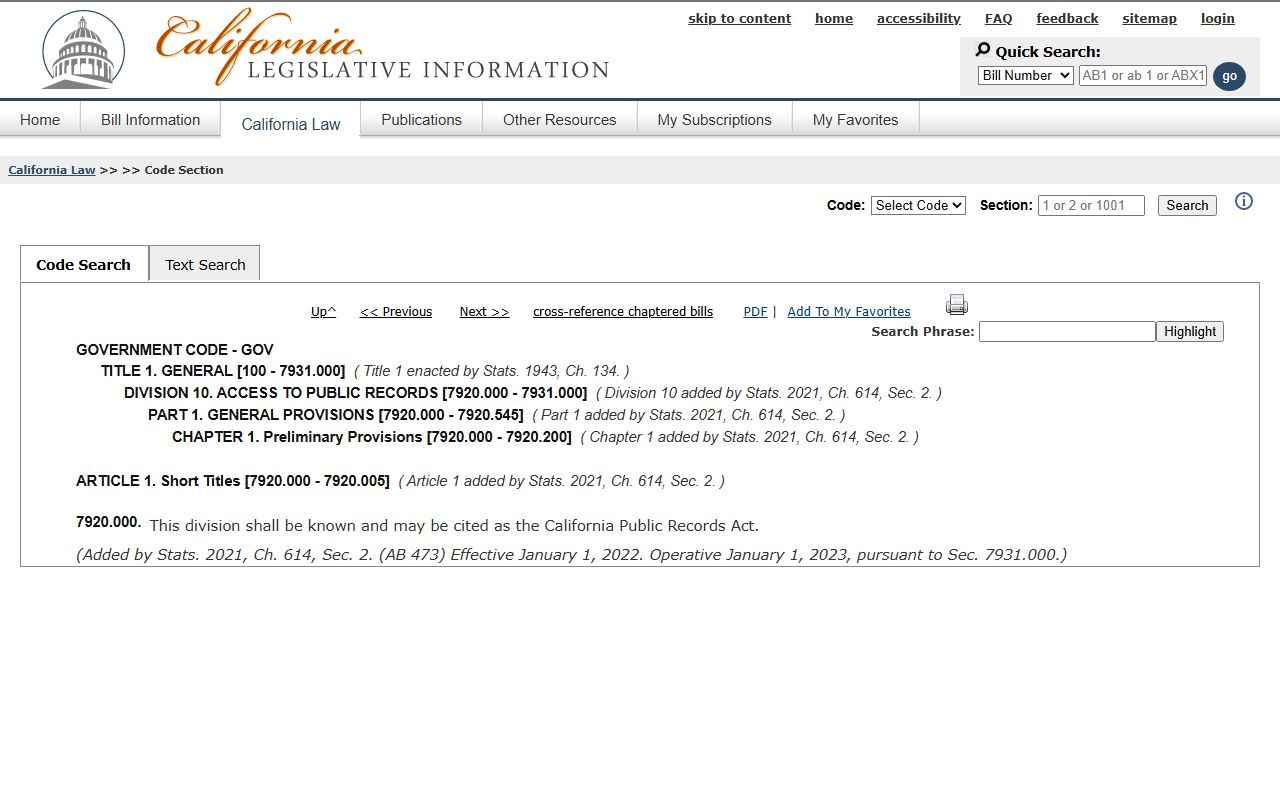
The California Public Records Act is the main state law for public access to government files. The CPRA was first enacted in 1968 and was moved into a new code structure on January 1, 2023. It now starts at Government Code § 7920.000. The Act applies to state and local agency records, which covers the Alameda County Sheriff, the District Attorney, the Probation Department, the Auditor-Controller, the Clerk-Recorder, and most other county offices.
The Act sets a default rule of access. Records held by a public agency are open unless a statute makes them exempt. Common exemptions cover active investigations, personnel files, medical files, attorney work product, and trade secrets.
The screenshot below comes from the California Legislative Information page for the CPRA.
Court Records vs Public Records vs Recorded Documents
Public records in Alameda County run on three tracks. Each track has its own office, form, and fee. Mixing them up is the top reason a request is bounced back.
Court case records are the files of an open or closed court case. A divorce decree, a civil complaint, or a criminal minute order is a court case record. Those are pulled through the Alameda County court records process, not a CPRA request. The civil, family, and probate side uses eCourt. Criminal uses Odyssey. Walk-in and mail copy requests go to the Records Office at the René C. Davidson Courthouse, 510-891-6005.
Judicial administrative records are court policies, contracts, and budgets. Those use California Rules of Court rule 10.500. County agency records are what the CPRA was built for and most run through NextRequest.
| Track | What It Covers | Where to Send It |
|---|---|---|
| Court case records | Complaints, decrees, motions, orders, minute orders, dockets | Superior Court Records Office or eCourt / Odyssey portals |
| Court administrative records (rule 10.500) | Court policies, court budgets, court contracts, internal writings | Public Access Request, 1225 Fallon Street, Room 209, Oakland |
| County agency records (CPRA) | Sheriff, DA, Probation, Auditor, Public Works, and other county files | NextRequest portal or the holding department |
| Recorded documents | Deeds, liens, maps, fictitious business names, notary filings | Clerk-Recorder index at rechart1.acgov.org and copy orders |
| Vital records | Birth, death, marriage certificates | Clerk-Recorder vital records orders, in person, mail, or online |
Knowing which row applies is half the work. The other half is filling out the right form and paying the right fee.
Alameda Judicial Administrative Records
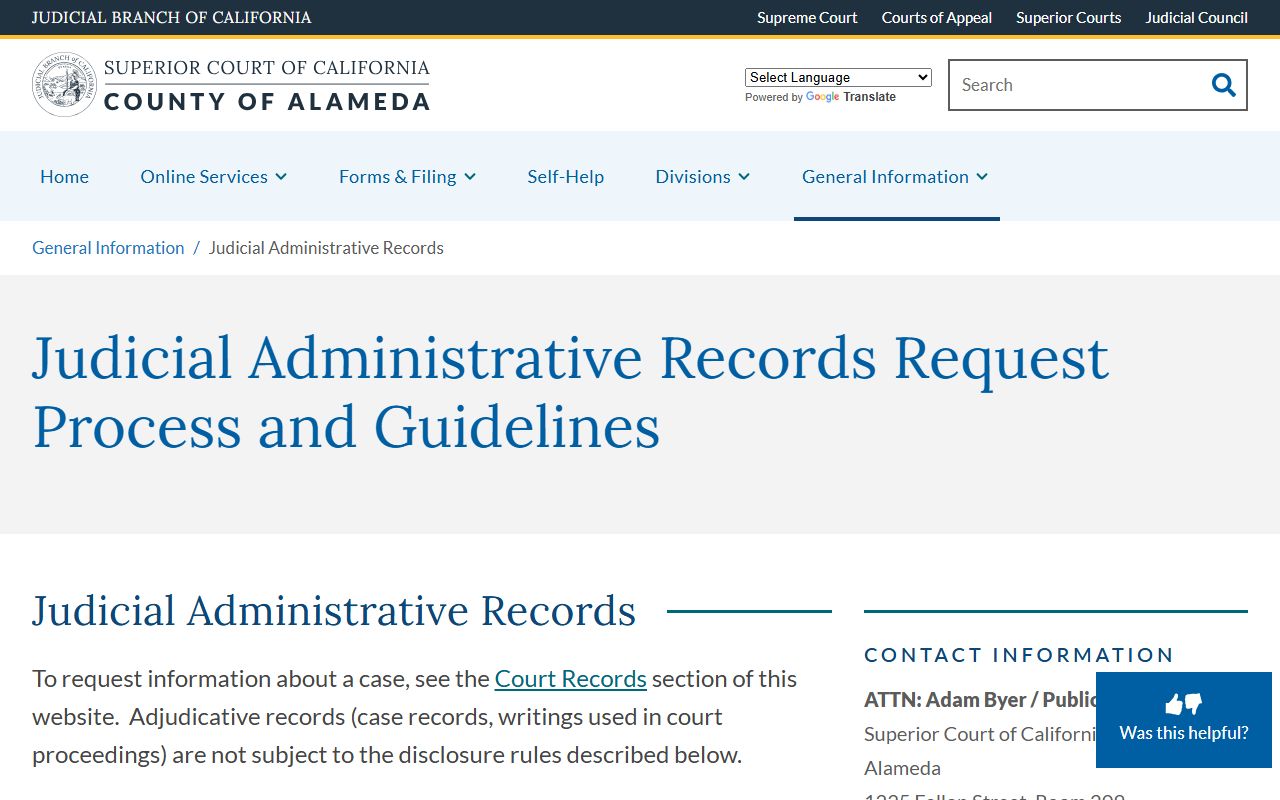
The Alameda Superior Court treats rule 10.500 requests as a separate channel from case records. The court's own page is clear that case information is not the same thing as administrative records. A request for a case file should go through the Records Office, not the rule 10.500 channel.
Rule 10.500 covers non-adjudicative writings held by the court. That includes budgets, written policies, statistical reports, and contracts. The request must be written, must give the requester's name and contact info, and must describe the record well enough for staff to find it.
The screenshot below comes from the official Alameda Superior Court Judicial Administrative Records page.
The court does not accept rule 10.500 requests by fax. Mail and email are the two normal ways in. Fees may apply under rule 10.500(e)(4).
Public Access Request (Rule 10.500)
ATTN: Adam Byer
Superior Court of California, County of Alameda
1225 Fallon Street, Room 209
Oakland, CA 94612
Alameda Clerk-Recorder Public Records
The Alameda County Clerk-Recorder sits inside the Auditor-Controller agency. The office holds vital records, marriage services, recorded official documents, fictitious business names, notary filings, and several professional registrations. The main office is at 1106 Madison Street, Oakland, CA 94607. The Tri-Valley branch is at 7600 Dublin Boulevard, Suite 160, Dublin, CA 94568. The customer line is 1-888-280-7708.
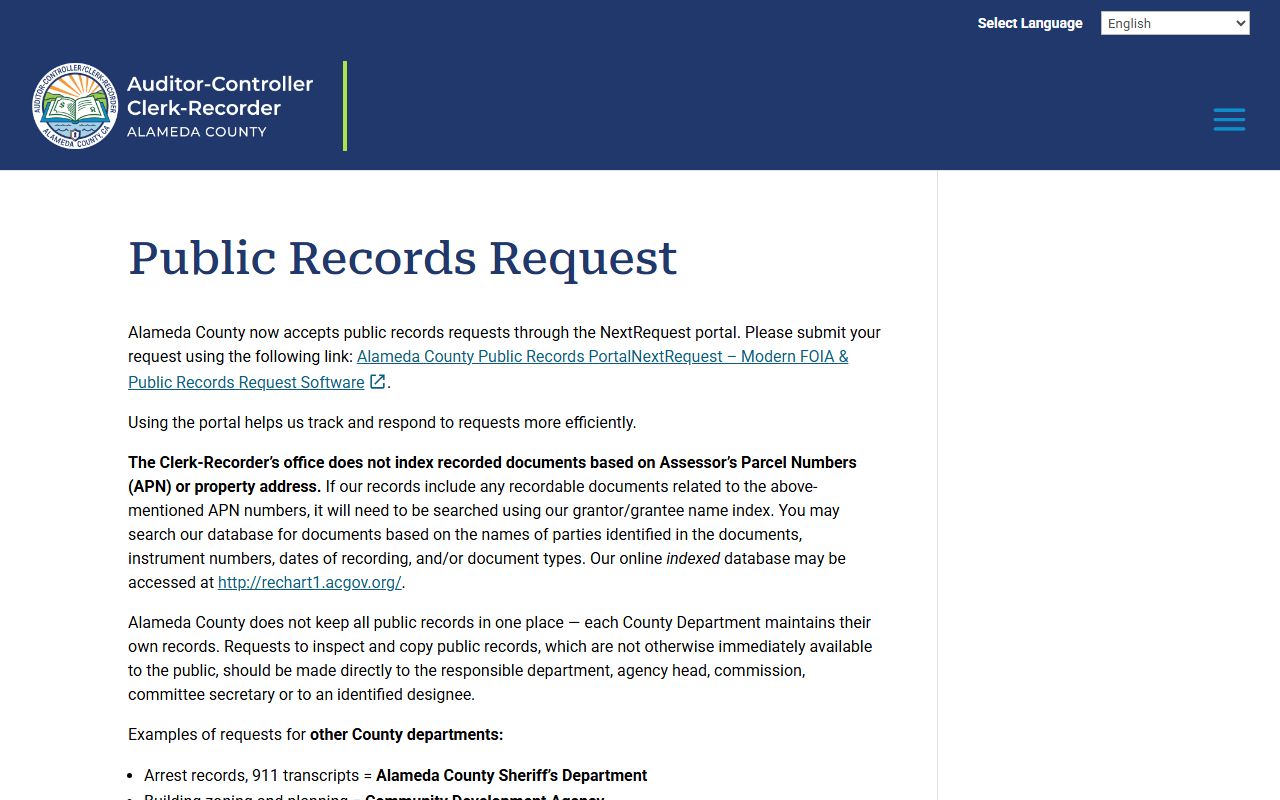
A regular copy purchase at this office is not a CPRA request. It uses the office's own order forms and fee schedule. The Clerk-Recorder accepts CPRA-style public records requests through NextRequest. The public records request page notes that each Alameda County department keeps its own records.
The screenshot below comes from the official Alameda Clerk-Recorder public records request page.
The recorded document index runs at rechart1.acgov.org. It is not searched by property address or by APN. It is searched by grantor or grantee name, by instrument number, by recording date, or by document type. Records from 1969 to the present are in electronic format. Records before 1969 are on microfilm and require a hand search at the office.
The screenshot below comes from the Alameda Clerk-Recorder public record index.
The index gives users instrument numbers, book and page, and document type. Those values are needed to order a copy of any specific recorded file.
Document Image Limit Under Gov Code § 7928.215
One of the most common questions at the Clerk-Recorder is why the office shows the index online but not the document images. The answer is in state law. Government Code § 7928.215 blocks county recorders from posting full images of recorded documents on a public website that can be reached from home. The intent is to limit identity theft tied to deeds and similar files that may carry signatures and personal data.
So the index search works from any browser. The actual image of a deed, a lien, or a release does not. To view a recorded image, a user can come to the Clerk-Recorder office and view it on site. To get a paper copy, a user can place an in-person, mail, or online copy order through the office.
The screenshot below shows the Clerk-Recorder real property research request page.
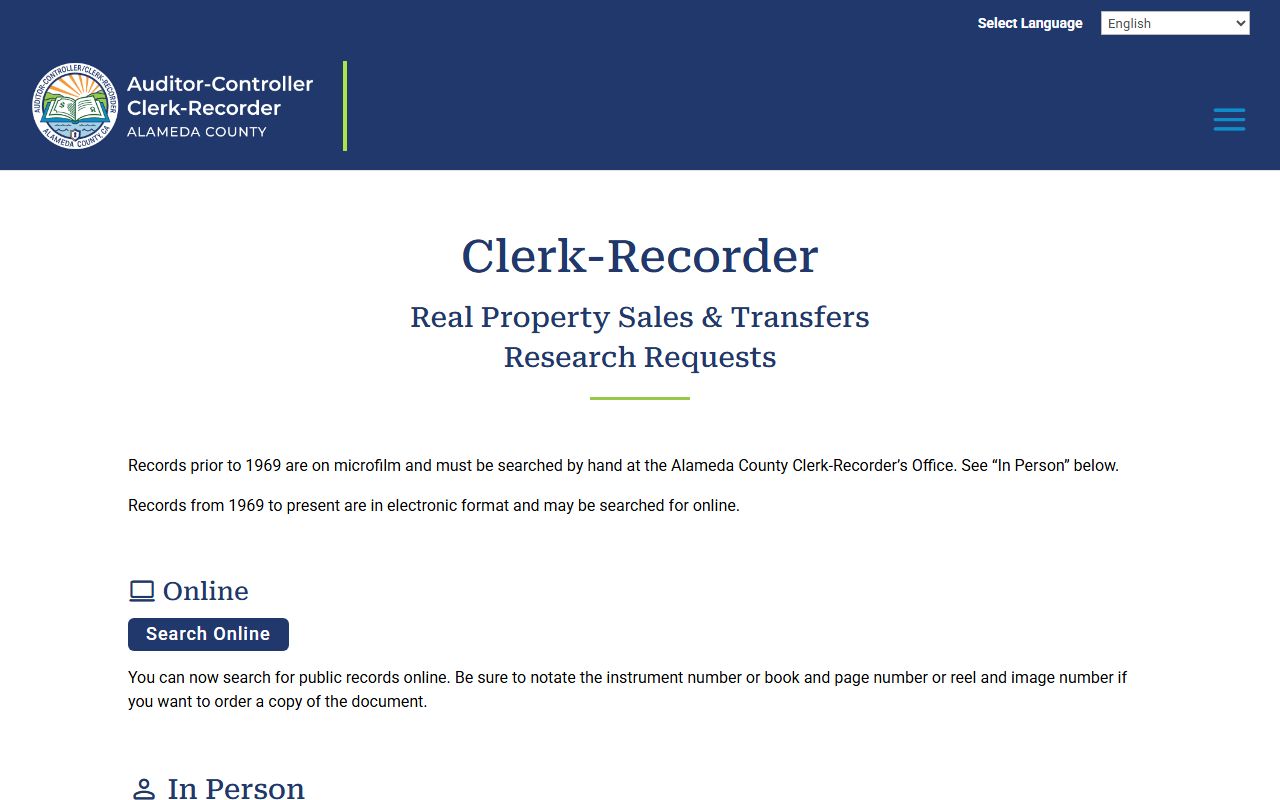
Real property research is a separate intake. The office asks users to note book and page or reel and image numbers when known.
How to File a Public Records Request
The steps below cover both the CPRA route to a county agency and the rule 10.500 route to the court. The more facts a requester gives, the faster the office can search. A clean Alameda County public records request runs in this order.
- Pick the right office. County files use NextRequest or the holding department. Court case files use the Records Office at 510-891-6005. Court administrative files use the rule 10.500 mail or email route. Recorded deeds use the Clerk-Recorder index. Vital records use the Clerk-Recorder order forms.
- Describe the record clearly. Give a record type, a date range, the office that holds it, and any case or instrument number.
- Pick a delivery method. Most CPRA requests can be filled in PDF by email at no charge. Paper copies trigger duplication fees. Certified copies trigger a separate fee.
- Submit the request. For county departments, the most common path is NextRequest. For rule 10.500, send the request by mail to Public Access Request, 1225 Fallon Street, Room 209, Oakland, CA 94612, or by email to PubAccessRequest@alameda.courts.ca.gov.
- Wait for an acknowledgment. The CPRA gives the agency ten days to respond on whether records exist and can be released. Production may take longer.
- Pay any fees. Direct duplication costs are typical. The court can charge fees under rule 10.500(e)(4).
- Pick up or download the records. PDF delivery by email is common. Paper copies can be mailed or picked up at the office that holds the record.
A focused first request often saves a back-and-forth.
Fees and Payment
Fee rules in Alameda County depend on the office and the record type. The court keeps its own Fee and Bail Schedules page. CPRA fees at most county departments are limited to direct cost of duplication. Rule 10.500(e)(4) allows the court to charge for copying and production of administrative records.
| Item | Amount |
|---|---|
| Recorded document copy (Clerk-Recorder) | $3.50 per page plus $1.00 certification |
| Notary bond and oath filing | $50.00 standard one-page bond plus one-page oath; $3.00 per added page |
| Certified copy of marriage record | $21.00 each |
| Public marriage license | $81.00 |
| Confidential marriage license | $90.00 |
| In-person credit card transaction fee | 2.3% |
| Court administrative records (rule 10.500) | Copy and production fees may apply |
| County CPRA copies (NextRequest) | Direct cost of duplication; PDF email often free |
The Clerk-Recorder accepts cash, debit, ATM, major cards, and checks made out to the Alameda County Clerk Recorder. Mail payments use a check, money order, or cashier's check.
The screenshot below comes from the Alameda Superior Court Fee and Bail Schedules page.
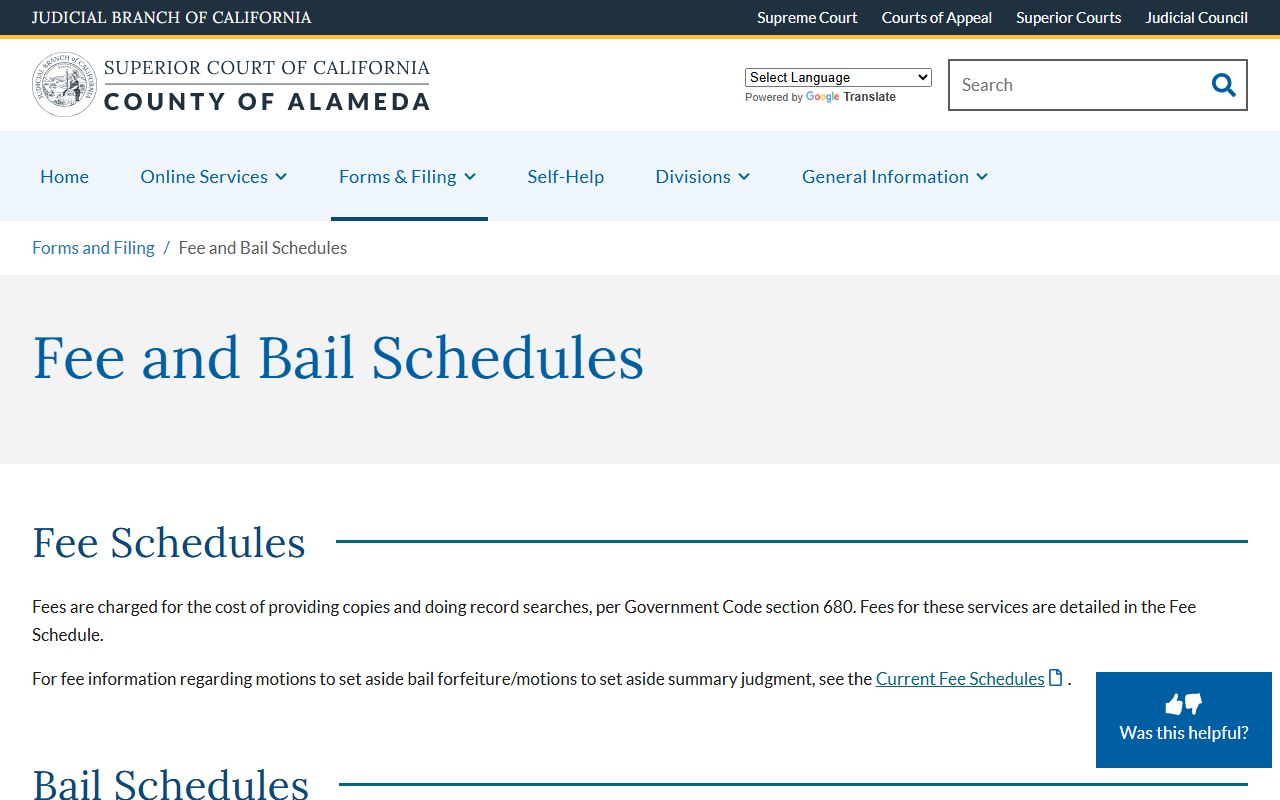
Court filing and copy fees follow the statewide Judicial Council uniform fees. A fee waiver may be granted for low-income filers under Government Code § 68631.
Public Records Request Form Fields
Most Alameda County public records request forms ask for the same core set of fields. The list below is drawn from the court's Civil Records Request Form and the Clerk-Recorder order forms. A clean request fills in as many of these as the user knows.
| Field | What to Enter |
|---|---|
| Requester Name | Full legal name of the person making the request |
| Mailing Address | Street, city, state, ZIP for mail responses |
| Phone Number | Daytime phone so staff can clarify or call back |
| Email Address | Preferred for PDF delivery and status updates |
| Description of Record | Plain English record type, office, or program |
| Date Range | Start and end date narrows the search and the fee |
| Document Type | Deed, lien, contract, policy, email, report, log |
| Case or Instrument Number | When known, the fastest way to find a record |
| Delivery Method | Email, mail, or in-person pickup |
| Payment | Cash, check, money order, debit, credit, or fee waiver |
| Signature | Required on some vital records under penalty of perjury |
Note: Vital record orders for an unrestricted certified copy add a sworn statement or notarized authorization, and online orders add an identity check by electronic ID.
Department-by-Department Requests
Alameda County does not keep all public records in one place. Each department maintains its own records. The route to a Sheriff use-of-force log is not the same as the route to a Public Works contract. NextRequest is the main intake for most county departments, but the file itself is held and released by the department that owns it.
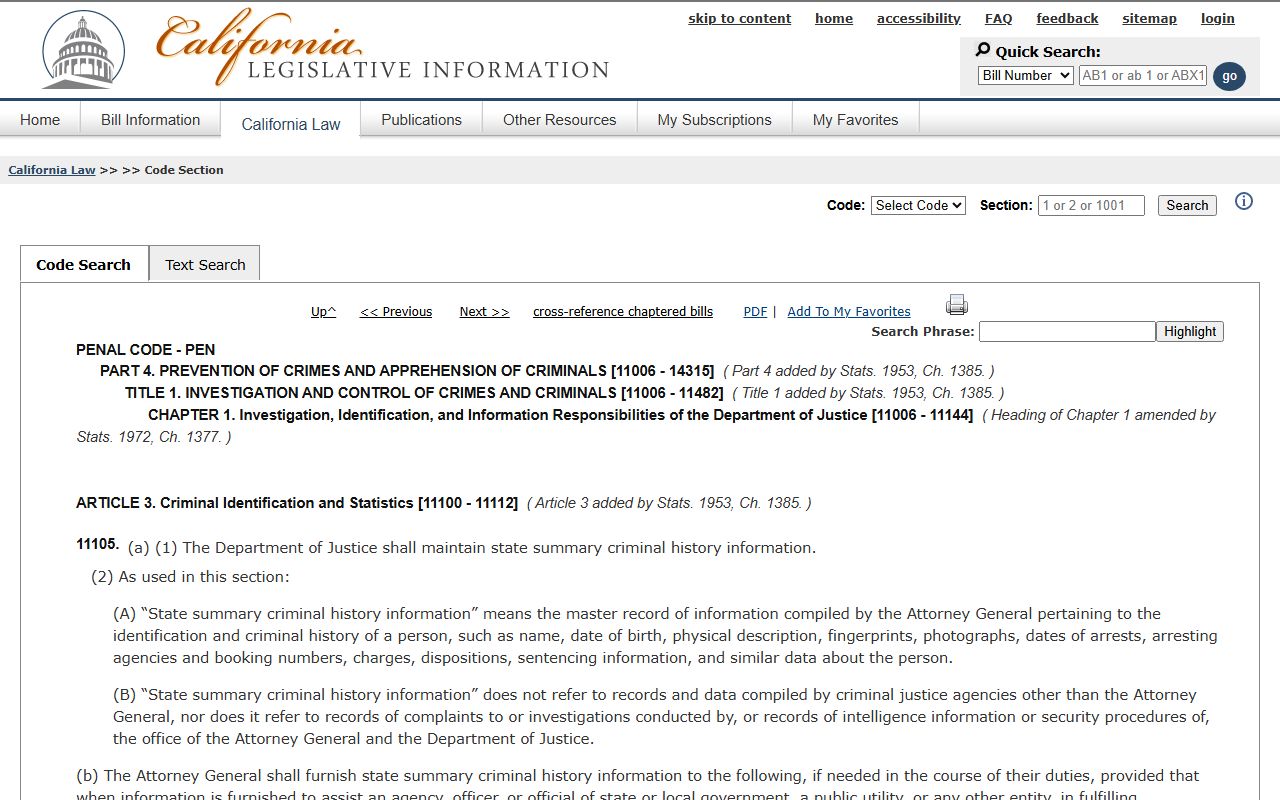
This split shows up most for criminal-history-style requests. State summary criminal history under Penal Code § 11105 is held by the California Department of Justice, not by Alameda County. A CPRA request to the county will not pull that record. Arrest files from the Sheriff or a city police department are separate, and the Sheriff arrest records tool does not equal a full criminal history.
The screenshot below comes from the official Penal Code § 11105 page.
The split matters for marriage and divorce too. Marriage licenses sit with the Clerk-Recorder. Divorce decrees sit with the Superior Court family law division. See the Alameda County marriage and divorce records page for the full split.
Response Timelines
The CPRA gives a county agency ten days to respond on whether records exist and can be released. That ten-day clock is the response, not the full production. The agency can extend the clock by up to fourteen days when the request is unusual or needs records from a field office. Production of the actual records can take longer.
Rule 10.500 does not set a single fixed clock for court administrative records, but the court is expected to respond promptly and to give a clear timeline for production. A focused, narrow request gets a faster answer. A broad request can trigger a back-and-forth as staff work with the requester to narrow it.
Note: A vital record copy through the Clerk-Recorder is not a CPRA request and runs on the office's own processing schedule.
Confidential and Restricted Records
Several record types in Alameda County are not open to the public, even with a CPRA or rule 10.500 request. The most common ones are juvenile case files under Welfare and Institutions Code § 827, sealed court records under California Rules of Court rule 2.550, and adoption records under Family Code § 9200. Mental health, CARE Act, and conservatorship files carry medical material shielded by statute.
Criminal record relief is its own area. Arrests that did not lead to a conviction may be sealed under Penal Code § 851.91. A higher factual innocence standard is set out in Penal Code § 851.8. None of these are CPRA requests. Each runs through the court that handled the case.
Key Statutes for Alameda County Public Records:
Government Code § 7920.000 - California Public Records Act.
Government Code § 7928.215 - Block on online recorded document images.
Welfare and Institutions Code § 827 - Juvenile case file confidentiality.
Penal Code § 851.91 - Sealing an arrest with no conviction.
Personal data is also protected inside public files. Social Security numbers, account numbers, medical data, and the names of minors are redacted in most releases. The law enforcement exemption keeps active investigation files out of view until the case is closed. See the Clerk of the Superior Court page for court-side copy steps and the court records page for case lookup steps.