
Where Alameda Probate Cases Are Filed
The Alameda County Probate Division sits in one place. Every probate filing in the county goes to the Berkeley Courthouse at 2120 Martin Luther King, Jr. Way. The court does not split probate between Oakland and Berkeley. The Berkeley clerk takes the papers and routes the calendar from there. A two court day cutoff applies to all filings.
Berkeley Courthouse, Probate Division
2120 Martin Luther King, Jr. Way
Berkeley, CA 94704
510-647-4439
Most hearings sit at Berkeley. The René C. Davidson Courthouse hosts Department 1B for a small share of probate work. The phone line at 510-647-4439 handles filing questions, hearing dates, and packet pickup. Clerks cannot give legal advice.
Probate Case Types in Alameda County
The Probate Division hears a wide set of matters under the California Probate Code. The most common Alameda case types are decedent estates, trusts, conservatorships, guardianships of a minor, and small estate proceedings. The court also handles disputes about wills, trusts, and powers of attorney, plus reviews and accountings filed by a conservator or guardian. Each case type has its own filing packet and its own hearing rhythm.
- Decedent estates. The court appoints a personal representative, sets bond if needed, and approves the inventory, creditor notice, accounting, and final distribution.
- Trusts. Trust administration petitions, requests to confirm or remove a trustee, accountings, and disputes about trust terms.
- Conservatorships. For an adult who can no longer care for self or estate. The case can cover the person, the estate, or both.
- Guardianships. For a minor when a parent cannot care for the child or the child's estate.
- Small estates. A Small Estate Affidavit may move a small estate outside full probate, under Probate Code Section 13100.
- Will and trust contests. A challenger asks the judge to rule on the validity of a will, trust, or power of attorney.
How to Search Alameda Probate Records
Probate case data sits in eCourt. The portal requires a free account before a search will run. Once signed in, the user can run a case number search, a name search, or a calendar search, and can pull public filing reports. Document downloads cost credits. The portal does show a free half-page preview of each document, which is a quick way to confirm the right filing before any payment.
- Open the eCourt Public Portal and sign in. New users register for a free account first.
- Pick a search mode. Use Case Number Search when the probate case number is known.
- Use Name Search to look up a decedent, conservatee, minor, petitioner, or party by name. Last name first is the safest format.
- Use Calendar Search to view probate hearings by date. Set the Department dropdown to the Berkeley Courthouse or to the René C. Davidson Courthouse Department 1B as needed.
- Open the case file. Read the register of actions, the parties, and any examiner notes posted for the next hearing.
- Tap a filing to load the free half-page preview. If the right document is on screen, buy the full copy with portal credits.
- For a sealed file, a juvenile guardianship subset, or a case that simply will not load, call the Probate Division at 510-647-4439.
The screenshot below comes from the official Alameda County Probate Division page, which describes filing location, hearing calendars, and the examiner note workflow.
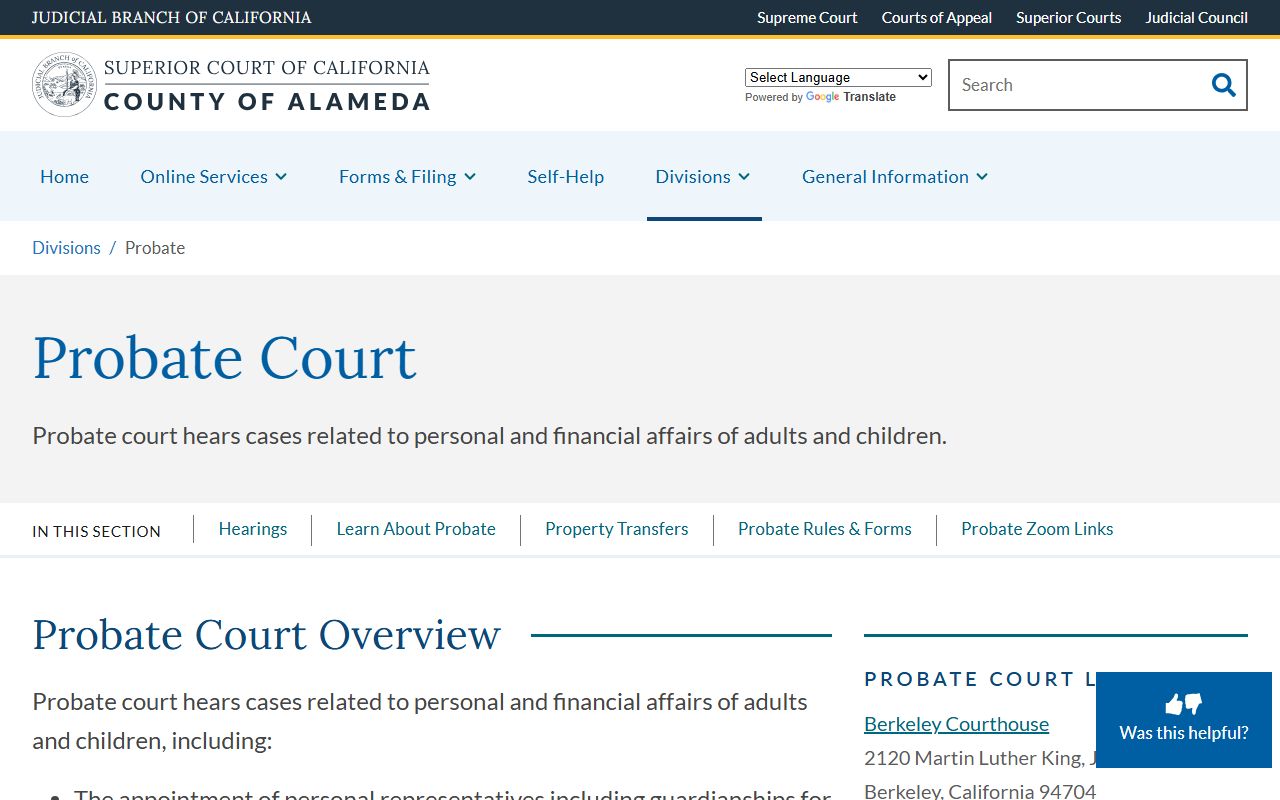
The same page is useful for confirming the Department setting before a calendar search. A Berkeley search and a Department 1B search return very different hearing lists.
Probate Search Fields
The eCourt probate search uses a small set of fields, but the right mix saves time. The table below lists the search fields the public portal exposes for probate matters, based on the Alameda probate division page.
| Field Label | Type | Required | Notes |
|---|---|---|---|
| eCourt account login | Account | Yes for all functions | Free registration. Required before any search or document view. |
| Case Number Search | Search mode | Optional | Best when the probate case number is already known. |
| Name Search | Search mode | Optional, may use credits | Search decedent, conservatee, guardian, petitioner, or party name. |
| Calendar Search | Search mode | Optional | Pulls probate calendars by courthouse and by department. |
| Public Reports (Filings) | Report | Optional | Filing reports across a date range. |
| Department dropdown | Dropdown | Optional | Use Berkeley Courthouse for most probate, or RCD Dept. 1B for calendars assigned there. |
A name search is the common path when the case number is unknown. It may consume credits. A case number search is free and pulls a clean register of actions.
Examiner Notes and Calendars
Alameda probate runs on an examiner system. Before a hearing, a court examiner reads the filing and posts notes in eCourt. The notes flag missing items, point out service problems, and may recommend a ruling. A clean note often means the matter will be approved on the calendar date without argument. An open note means the petitioner must fix the issue or ask for a short continuance.
To pull the notes, sign in to eCourt, open the case, and look under the calendar tab. Set the Department dropdown to Berkeley or to RCD Department 1B based on the case assignment.
Filing cutoff. Probate papers must be filed no later than two court days before a hearing. A late filing usually pushes the matter off calendar.
Local Probate Forms and Packets
The Alameda court does the work of bundling local forms into named packets. A first time filer does not need to guess which forms go with which case type. The Probate Rules and Forms page lists each packet by name as a single download. Each packet pairs the Judicial Council statewide forms with the Alameda local forms and a short cover sheet.
- Probate Conservatorship Packet
- Temporary Conservatorship Packet
- Probate Guardianship Packet
- Temporary Guardianship Packet
- Termination of Guardianship Packet
- Probate Packet, Decedent's Estate
- Probate Small Estate Affidavit Packet
The page also posts standalone local forms, including the Limited Conservatorship Guardianship Flyer, the Conservatorship General Plan, the Status Report on Conservatee, the Guardianship Status Report GC-251, and the Small Estate Declaration under Probate Code Section 13100. Clerks cannot pick a form for a filer. The Self-Help Center and legal aid partners are the right next stop.
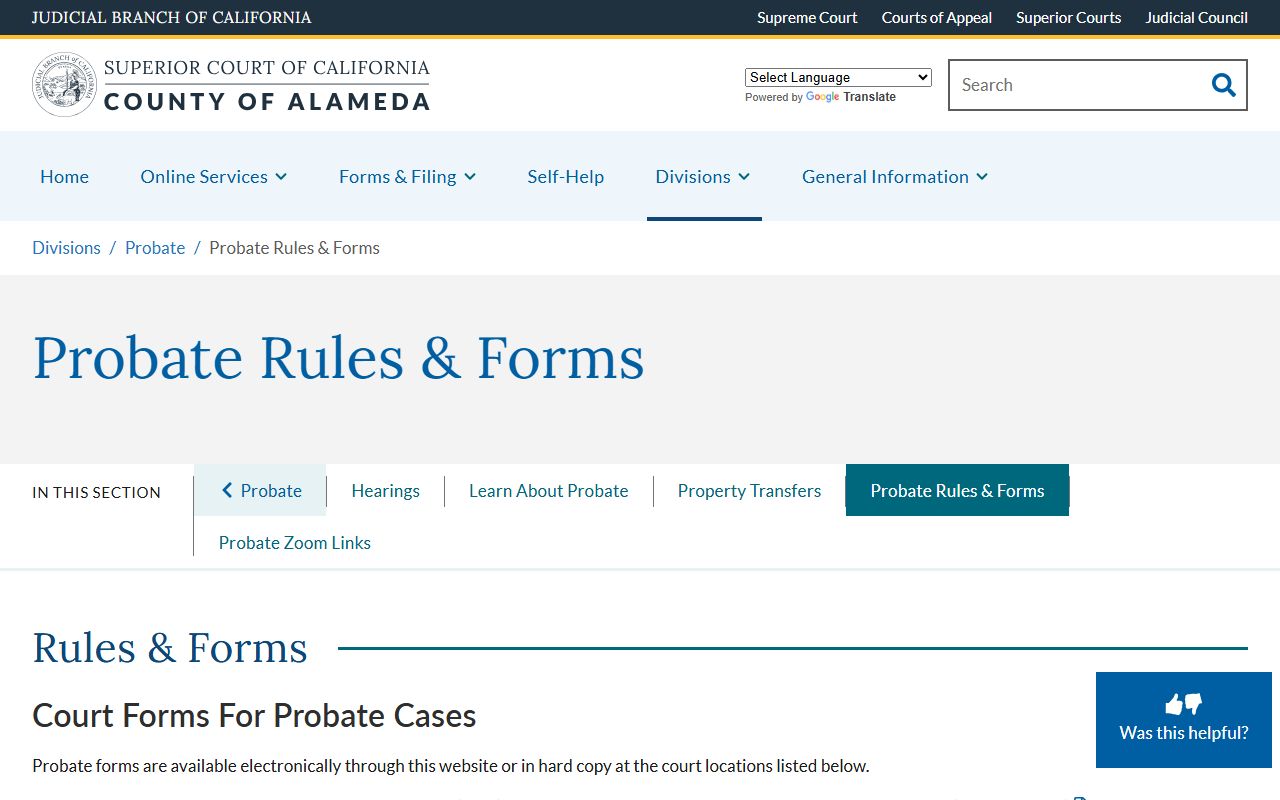
The screenshot below comes from the official Alameda Probate Rules and Forms page, which lists each local packet by name.
Filing Fees
Probate filing fees in California are set in the statewide Judicial Council uniform fee schedule and applied by each county court. Alameda keeps its current fee list on the Fee and Bail Schedules page. Specific dollar amounts for each probate petition type were not captured in current research, so a filer should confirm the live fee on that page before sending a check.
Note. Exact Alameda probate filing fee dollar amounts are not posted in this summary. Confirm any fee on the court Fee and Bail Schedules page before filing.
A low income filer may ask for a fee waiver under Government Code Section 68631. The court reviews income, household size, and assets. A granted waiver covers the first filing fee and most later fees in the same case.
Guardianships and Conservatorships
Guardianship is for a minor. Conservatorship is for an adult. Both run under court review, both can cover the person or the estate or both, and both require regular status reports.
A guardianship of the person gives the adult guardian the right to make care and school decisions for the minor. A guardianship of the estate covers the minor's money and property. The guardian must file status reports, and the court can ask for an accounting at any time. A general conservatorship is for most adults. A limited conservatorship is a narrower order for an adult with a developmental disability. Both forms of conservatorship need a court accounting, a care plan, and a status report on the conservatee.
Local help is at hand. Legal Assistance for Seniors at 510-832-3040 helps with guardianship of a minor and with limited conservatorship cases.
Probate Process Walkthrough
Most Alameda probate matters move through the same sequence. The exact path depends on case type. A decedent estate runs longer than a small estate affidavit, and a contested trust matter can take years.
- Pick the right case type. Is the matter a decedent estate, a trust petition, a guardianship, a conservatorship, a small estate, an accounting, or a dispute?
- Pull the matching Judicial Council and Alameda local packet. Read the cover sheet first. Clerks cannot give legal advice on which form fits.
- File the petition at the Berkeley Courthouse by the two court day cutoff. Pay the filing fee or apply for a fee waiver at the same time.
- Check eCourt for the hearing date, the assigned department, and any examiner notes posted before the hearing.
- Serve the required notices. Some matters also require publication in a local paper under California Probate Code rules.
- Attend the hearing. Resolve any examiner deficiency, ask for a short continuance, or accept a recommended ruling.
- Carry out the order. For an estate, that means inventory and appraisal, creditor notice, the final accounting, distribution, and discharge.
A guardianship or conservatorship adds ongoing status reports, care plan updates, and bond reviews. A small estate affidavit under Probate Code Section 13100 skips most court steps once the threshold and waiting period are met.
Probate Glossary
Probate uses a small set of legal terms that show up across every case type. The list below covers the most common terms on an Alameda probate docket.
- Testator
- The person who makes a will.
- Executor
- The personal representative named in a will to gather assets, pay debts, and pass property to heirs.
- Intestate
- Dying without a valid will. The estate passes under California intestate succession rules.
- Personal representative
- The court appointed person who runs an estate, named in a will or appointed when there is no will.
- Conservator
- A court appointed adult who manages another adult's care, finances, or both.
- Guardian
- A court appointed adult who cares for a minor or a minor's estate.
- Fiduciary
- A person, such as an executor, trustee, conservator, or guardian, who owes a duty of trust to another.
Self-Help Resources
Probate is one of the harder areas of court for a self-represented filer. The Alameda Superior Court runs a free Self-Help Center for help with forms, procedure, and next steps. Staff do not act as the filer's lawyer. The phone line is 510-272-1393, Monday through Thursday from 2:00 PM to 4:00 PM. LiveChat runs Monday through Thursday from 9:00 AM to noon.
Legal Assistance for Seniors at 510-832-3040 helps with guardianship of a minor and limited conservatorship work. For broader case lookups, see the Alameda County court records page, the Clerk of the Superior Court page, and the marriage and divorce records page. Common follow-up questions are on the Alameda County Court Records FAQ page.