
How to Search Alameda County Warrants
Alameda County does not run a single public site that lists every active warrant by name. The honest path is to route through the court tools that show case status, then call the criminal division clerk for the courthouse on the case. The Superior Court keeps a free Find Your Court Date tool that pulls up to five days of court calendars. If a bench warrant has been issued for failure to appear, the criminal case often still shows in that tool or in the court's criminal division records system.
The court keeps criminal records out of eCourt. Criminal cases sit in the Criminal Online Records Search, also called the Odyssey portal. It needs a free account. A name search may flag an open case, a future court date, or a missed date that triggered a warrant. The court will not confirm a warrant by email, so a clean check still needs a phone call to the right clerk or a visit through counsel.
- Open the Find Your Court Date tool and run the name. Note any criminal case number that shows up.
- Sign in to the Odyssey criminal portal and run Smart Search on the same name.
- If a criminal case appears with no future date set, that can mean a warrant was issued after a missed appearance.
- Call the criminal division clerk for the courthouse on the case. Have the case number, full name, and date of birth ready.
- If a Sheriff inmate hit appears, also check the Alameda County inmate records page for booking detail.
- For a warrant tied to a felony or no-bail hold, talk to counsel before any in-person step.
Why No Public Active-Warrant Portal Exists in Alameda
The research for this site looked for a countywide active-warrant search and did not find one. The Sheriff site has a Most Wanted page, but Most Wanted is a short curated list of high-priority cases, not a name-based warrant lookup. The court runs criminal records through Odyssey, but Odyssey is a case search, not a warrant search. A bench warrant shows up inside the related case file, not on a stand-alone warrant index.
Important: Third-party warrant sites that promise an Alameda County active-warrant search are not official, and a clean hit or miss on those sites should never be trusted.
State law protects ongoing investigations from open disclosure. The court treats a bench warrant as part of the case file, not as a separate public record. Sheriff data on active warrants is shared with other police agencies through closed law-enforcement systems, not with the public. The court can confirm a warrant on a known case, the Sheriff can act on a warrant during a stop or jail booking, and the public can find out by calling the criminal clerk or by checking the criminal case in Odyssey.
Types of Warrants Used in Alameda County
Three main types of warrants move through Alameda County Superior Court. Each comes from a different point in a case. The terms get mixed up in daily talk, so a short list helps.
- Arrest warrant - Signed by a judge based on a sworn statement that gives probable cause to believe a person broke the law. It allows police to take the person into custody.
- Bench warrant - Issued from the bench when a person fails to appear at a set court date, breaks a court order, or fails to pay an ordered amount. Most Alameda bench warrants tie to a missed criminal hearing.
- Search warrant - Signed by a judge to let police search a place, a vehicle, or a device for named items linked to a crime. It does not direct an arrest on its own.
The Alameda criminal division also notes that a criminal protective order can lead the court to update the automated warrant system. When a judge enters a protective order at a victim's request or on the court's own motion, the arresting agency is notified, and the system is updated so police can act on the order at any later contact.
Bench Warrants for Failure to Appear
The most common Alameda bench warrant starts with a missed court date. Alameda criminal court says court appearances are mandatory. If a defendant fails to appear, a bench warrant can be issued. If the person was out on bail, the court may order bail or bond forfeited. The court may also impose a $300 civil assessment under Penal Code § 1214.1. That assessment is a civil money judgment, not a criminal fine, and it sits on top of any underlying fines.
To add or change a court date, the court tells represented people to contact their attorney. Unrepresented people should call the criminal clerk at the courthouse on the case. If the case sat on a bail bond, the person may also need to call the bail company. None of that should be tried without legal advice on a felony case.
Criminal Division Clerk Phones
The right clerk depends on which courthouse holds the criminal case. The Superior Court lists a direct line for the criminal clerk at each of the main criminal courthouses. Use the line that matches the case location, not a general court line.
Wiley W. Manuel Courthouse
661 Washington Street
Oakland, CA 94607
510-627-4702
Criminal Division Clerk
René C. Davidson Courthouse
1225 Fallon Street
Oakland, CA 94612
510-891-6009
Criminal Division Clerk
Fremont Hall of Justice
39439 Paseo Padre Parkway
Fremont, CA 94538
510-818-7501
Criminal Division Clerk
East County Hall of Justice
5151 Gleason Drive
Dublin, CA 94568
925-227-6792
Criminal Division Clerk
Hayward Hall of Justice
24405 Amador Street
Hayward, CA 94544
510-690-2703
Criminal Division Clerk
The screenshot below comes from the Alameda Superior Court phone and fax directory, which lists each division line and email address.
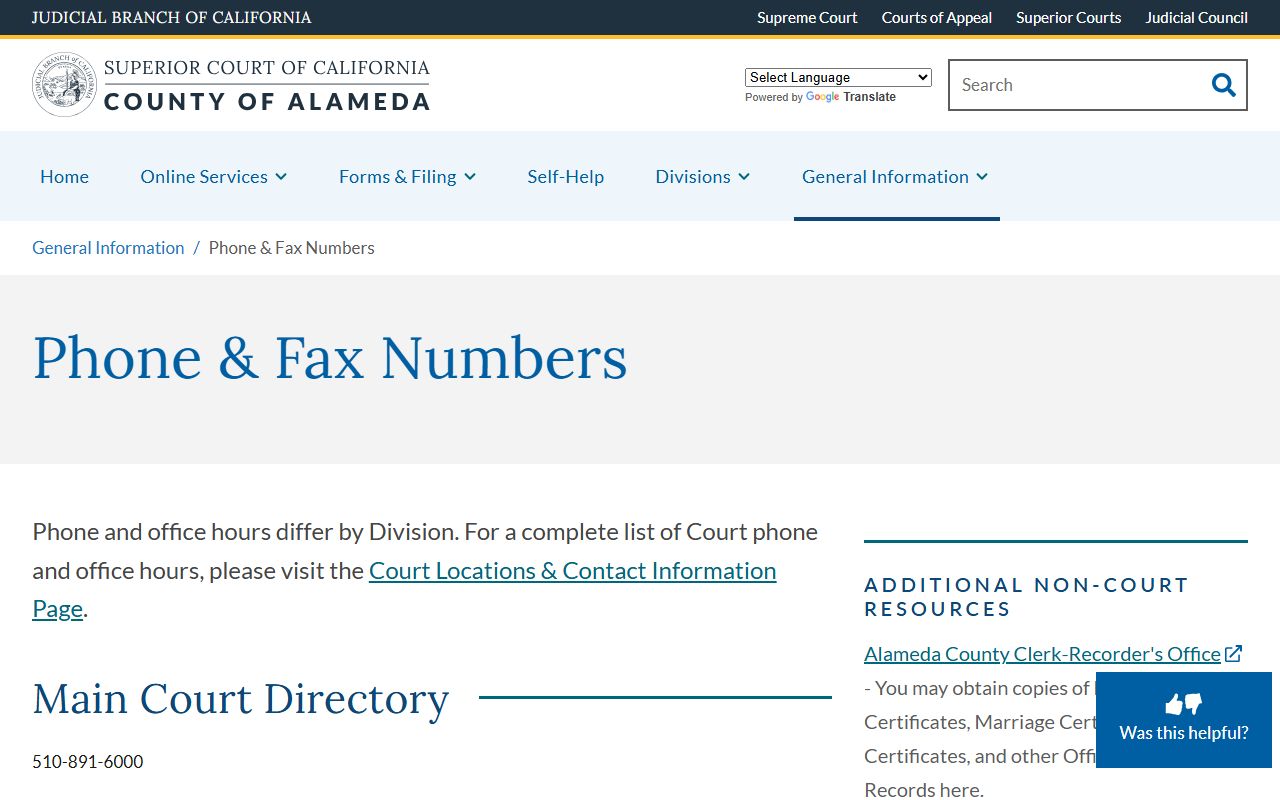
That directory is the safest way to confirm a clerk line before a call, since the court moves division phones from time to time.
Sheriff Most Wanted vs Active Warrant Search
People often type Most Wanted into a search box and expect a full warrant list. The two are not the same. The Alameda County Sheriff site posts a Most Wanted page that names a small set of high-priority fugitives. It is built for tips, not for a private name check. A clean miss on Most Wanted does not mean a person has no warrant.
| Feature | Sheriff Most Wanted | Active Warrant Search |
|---|---|---|
| Source | Sheriff public affairs | Court case files / police systems |
| Scope | Small curated list, often violent felonies | Every open warrant in the county |
| Public access | Open web page with photos | Not published countywide in Alameda |
| Best use | Anonymous tips to help police | Confirming a personal warrant status |
| Cost | Free | Free phone call to criminal clerk |
For a real personal check, the criminal case in Odyssey plus a call to the right criminal clerk does the job that no online warrant search can do in this county.
How to Resolve an Outstanding Alameda Warrant
The court treats a warrant as live until a judge recalls it. Doing nothing risks an arrest at a traffic stop, an airport check, a job background screen, or a routine call for service. The court route below tracks the official path the criminal clerks and Public Defender describe.
- Skip the third-party warrant sites. None of them can recall a warrant.
- Pull the criminal case through the court date tool and the Odyssey portal. Note the case number, the courthouse, and any pending date.
- Call the criminal clerk at the listed courthouse. Ask whether the warrant is active and what the court allows next, such as a walk-in date or a calendar request.
- If counsel is on the case, call counsel first. Counsel can often calendar a warrant recall hearing without a custody hold.
- If a bail bond was posted, call the bail company. The bond agent may have steps to keep the bond live.
- Bring ID, the case number, and proof of any completed payment, class, or community work when going to court.
- Expect possible arrest if the warrant is active. Felony, no-bail, probation, or out-of-county holds need a lawyer first.
The Alameda County Public Defender, led by Brendon D. Woods, takes appointed criminal cases for people who cannot afford counsel. The office runs a Clean Slate unit for record remedies and can advise on a bench warrant tied to an open case.
Bail and Bond Consequences
A missed date can cost more than a warrant. The court can order bail forfeited under the Penal Code. A bail bond company that posted the bond then faces a forfeiture clock and may push hard for the person to come back to court. The $300 civil assessment under Penal Code § 1214.1 can stack onto any unpaid base fine, so the total owed can grow fast.
A judge can lift forfeiture if the person appears within the set window and shows a valid reason for missing the date. People released on their own recognizance face a similar risk. The court can revoke OR release and set bail at a new amount once a bench warrant clears.
Protective Orders and the Warrant System
Alameda's criminal division explains that a criminal protective order can be sought by victims or witnesses. The judge may order one on the court's own motion or at the DA's request. The arresting agency is notified, and the automated warrant system is updated. That update lets any officer who later contacts the restrained person see the order during a records check.
A protective order is not the same as a warrant, but a fresh violation can lead to a new arrest warrant for contempt or a new criminal charge. Civil restraining orders from family or civil harassment cases work the same way. People served with a protective order should read it line by line and ask the clerk or counsel about any unclear term before any contact with the protected person.
Role of Counsel and Legal Aid
A lawyer is the best first call on any warrant tied to a felony, a no-bail hold, a probation violation, or an out-of-county case. The Public Defender takes appointed cases for those who qualify by income and runs a holistic model that ties cases to housing, mental health, and immigration help. Private criminal defense lawyers handle warrant recalls and calendar requests on a flat fee or hourly basis. Self-Help can explain basic court process, but cannot give legal advice on a warrant.
Once the warrant clears, the criminal case still moves on. Open dockets and future hearings sit in the same Odyssey portal that the warrant search ran in, and show on the court dockets page. Background-check questions fall under the criminal records page. General record questions sit on the court records page and the Alameda County Court Records FAQ.